September 10, 2026 | Brazilian Butt Lift, Fat Transfer, Gluteal Fat Grafting
A patient came in last year with a printout of a news story about a woman who died after a Brazilian butt lift in another state. She put it on the desk and asked me, straight out, whether I could promise her that would not happen to her.
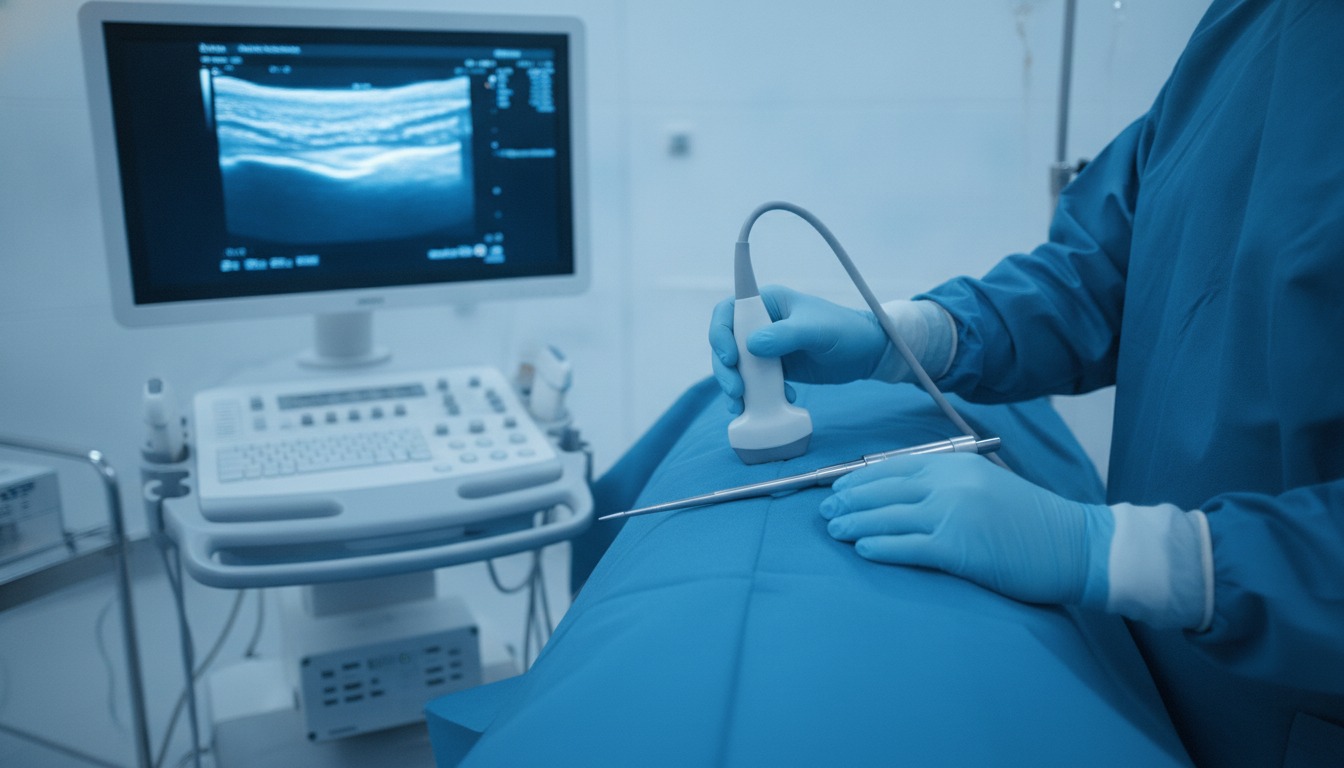
I cannot promise anyone an outcome. What I could do was show her the ultrasound machine and explain what it is for.
What does the ultrasound actually show you during a fat transfer?
Dr. Agullo: “The ultrasound shows us exactly where the tip of the cannula is while we’re injecting fat into the buttock. Ideally, the cannula should be injecting fat into the deep fat layer above the muscle. We inject some fat in the superficial fat layer for shaping, but the bulk of the volume is injected in that deep compartment.
“By visualizing exactly where we’re at, we’re avoiding intramuscular or deeper injections, which can cause fat embolism, a very severe complication. There have been no cases of fat embolus when fat has only been injected in the subcutaneous fat. The only cases of fat embolism have all had intramuscular fat injections. That’s the importance of the ultrasound. It makes the procedure safer by knowing exactly where you’re at at all times.”
Not most cases. All of them. The catastrophic BBL complication is fat entering a gluteal vein and traveling to the lungs, and it happens in muscle.
What does your protocol look like, and what changed after the 2024 study?
Dr. Agullo: “Even before 2024, I had already adopted many of the recommendations made beforehand and after by the plastic surgery societies. We continued using blunt tips with cannulas larger than 4 millimeters. We avoided injections into the muscle. We used ultrasound to visualize the location of the tip of the cannula while injecting, making sure not to perform any intramuscular injections. I always use an upward-angled cannula, and the patient is positioned in a jackknife type position.”
Five things. None of them dramatic on their own, and the screen runs the whole time.
What should a patient ask any surgeon about fat embolism risk?
Dr. Agullo: “The most important thing is whether the surgeon is using ultrasound or not. No matter the experience level of the surgeon, there’s always a risk that you can misjudge and be in the wrong plane, and this is completely avoidable with direct visualization.
“That’s especially true of male patients, who have a very thin fat layer, and also massive weight loss patients, who have a very thin fat layer, so they’re at higher risk for intramuscular injections.”
One question, then. Do you use ultrasound during the fat transfer?
Experience does not substitute for looking. And when there is barely any fat between skin and muscle, which is the situation in both groups he names, the margin for error shrinks to almost nothing.
What did your WAGS work change?
Dr. Agullo: “I think the biggest achievement of WAGS while I was Vice President and President was educating patients and surgeons, both members and non-members, about safety. Also incorporating ultrasound into the BBL procedure, and creating a course and a certification for using ultrasound for Brazilian butt lifts.
“We also showed that the BBL can be performed safely. I was one of the first plastic surgeons to hold the WAGS certification for ultrasound-guided fat transfer to the buttock.”
What This Means If You Are Considering a BBL
For years this operation carried the highest mortality rate in aesthetic surgery. That number was driven by one error, made in one plane of tissue.
Ask whoever you consult, in these words: do you use ultrasound guidance for the fat injection. If the answer is anything other than yes, keep looking.
Dr. Agullo is certified by the American Board of Plastic Surgery and the American Board of Surgery, completed his plastic surgery fellowship at the Mayo Clinic, and serves as Clinical Associate Professor of Plastic Surgery at Texas Tech University Health Sciences Center. He is a founding vice president and past president of the World Association of Gluteal Surgeons and has been a Castle Connolly Top Doctor for thirteen consecutive years.
Book a Consultation
If you are weighing a BBL, bring your questions about safety to the consultation. You will get a straight answer about your own anatomy, your own fat layer, and whether this operation is right for you.
Call (915) 590-7900, text 1-866-814-0038, or book online at agulloplasticsurgery.com. #StayBeautiful