
November 21, 2026 | Anti-Aging, Recovery, Skin Care Regimen
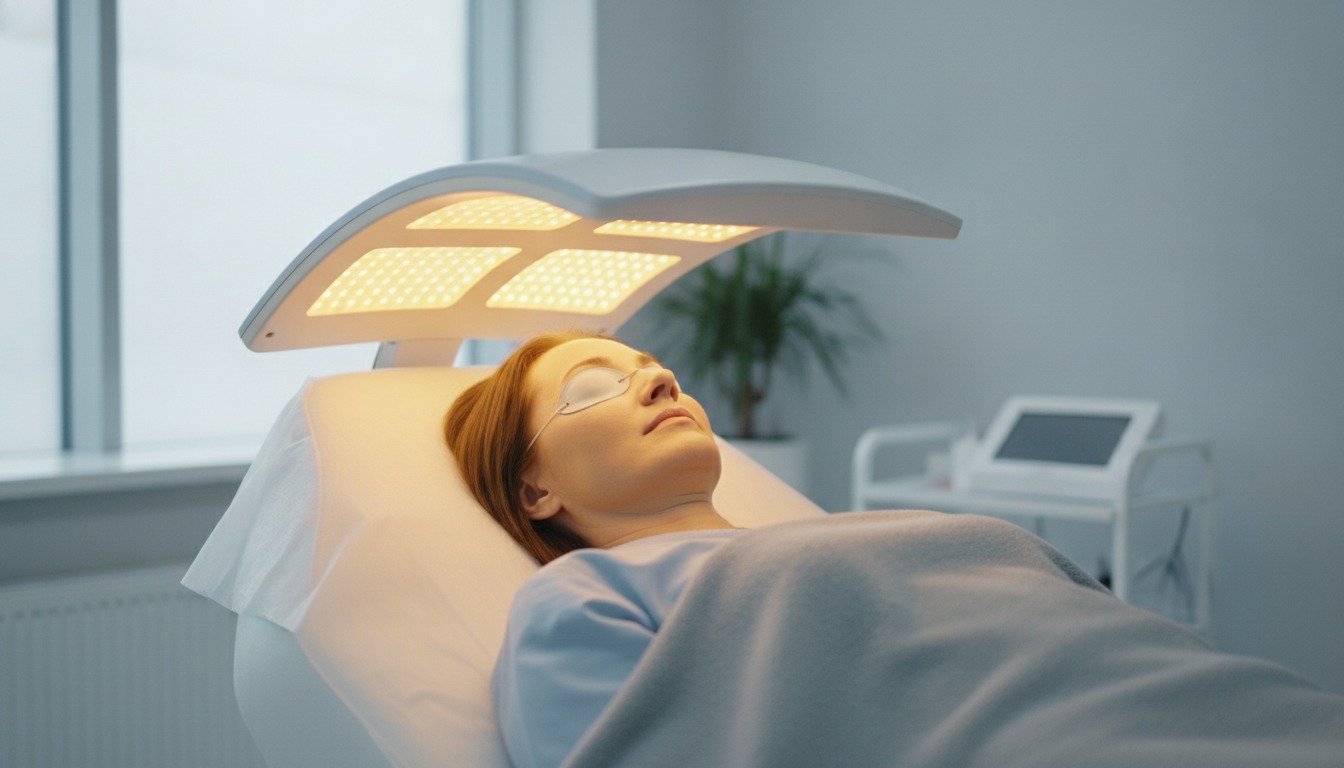
IPSY asked me in September whether yellow light therapy is the next big thing in skincare. Their piece ran on October 13 with six experts, and I was the only plastic surgeon in it.
My short answer was this:
“Yellow light is the peacemaker of the LED family. It will not fix a wrinkle and it will not clear acne, but for skin that runs red and reactive, it is one of the few things that calms it down without adding another ingredient the skin has to tolerate.”
Here is the longer one, starting with the cheat sheet.
The Three-Color Cheat Sheet
Yellow is for redness.
“Yellow, or amber, light therapy uses LEDs in roughly the 570 to 590 nanometer range. It sits between the green and red parts of the spectrum, and it belongs to the same family of low-level light treatments as red and blue light. It is non-thermal, so nothing is being heated or cut. You feel nothing beyond a mild warmth from the panel.”
“Light in this band is absorbed near the surface of the skin, mostly in the upper dermis and in the small blood vessels that sit there. The working theory is that it calms the inflammatory signals coming from those vessels and nudges skin cells toward repair. In practical terms, patients see less redness and a more even tone.”
Red is for collagen.
“Red light, around 630 to 660 nanometers, reaches the deeper dermis where collagen is made, which is why it is the one with evidence for fine lines and skin firmness. Yellow stays more superficial and works on tone and calming. In my office I often run them in sequence: red for structure, yellow for redness. If you can only buy one panel for aging, buy red.”
Blue is for acne.
“Blue light, around 415 nanometers, is absorbed by the bacteria that drive acne and is a treatment for breakouts. It penetrates very little and does nothing for redness. Yellow light goes slightly deeper and targets inflammation and vascular flushing rather than bacteria. If your problem is pimples, blue. If your problem is red and reactive skin, yellow.”
That is the whole sheet. Pimples, blue. Lines, red. Red and reactive, yellow.
What Yellow Does Well
“First, it reduces redness and flushing, which is why it is popular for sensitive and rosacea-prone skin. Second, it speeds recovery after procedures; I use it after laser resurfacing and peels to shorten the pink phase. Third, it improves tone and lymphatic drainage, so skin looks less puffy and blotchy. Fourth, it is one of the gentlest options in the LED family and almost never irritates. Fifth, it pairs well with everything else, because it does not thin the skin or make it sun-sensitive.”
And the caveat I gave IPSY in the same breath:
“The honest caveat is that the research on yellow light is thinner than what exists for red and blue, and most of the good data comes from in-office devices, not the masks sold online.”
Who Should Skip It
“The best candidate has redness, sensitivity, or post-procedure irritation, or simply wants a calmer complexion without adding an active ingredient. People with darker skin tones tolerate it well. I would skip it, or clear it with a physician first, if you are on a photosensitizing medication, have a history of light-triggered conditions such as lupus, or have an active skin cancer or an undiagnosed lesion in the treatment area. And if your goal is deeper wrinkles or acne, yellow light is the wrong tool.”
The Honest Part: Home Devices
This is the line IPSY printed, and it is the one I would underline.
“Yes, and safely, with the understanding that home devices deliver a fraction of the energy of a clinical panel. Consistency matters more than intensity: roughly ten to twenty minutes, three to five times a week, on clean, product-free skin, with eye protection if the device is bright. Expect a subtle change over six to twelve weeks, not a transformation.”
How to shop for one:
“I do not endorse a specific brand, and I would be cautious about any that claims to. What I tell patients to look for is a device that lists its wavelength in nanometers, states its power output, and carries FDA clearance for the LED category. Most reputable multi-color masks and panels include an amber setting; the single-color amber devices sold cheaply online often do not state their output at all, and that is the red flag.”
No nanometers on the box, no power output, no clearance? Put it back.
Where I Actually Use It: Recovery
In the office the panel is Elixir MD, and it runs far stronger than anything sold for home use. “We use blue, yellow, red, and infrared during recovery treatments.”
“We recommend Elixir MD, which is LED light therapy, for almost double the speed of recovery.”
It is part of the plan for facelifts, eyelids and body procedures, usually alongside lymphatic massage. This is how I put it to a tummy tuck and neck lift patient:
“We want to do some lymphatic massages after your surgery, so you’ll be coming for that and also for the LED lights. That combination really gets you going a lot faster.”
And to a facelift patient in August, about the bruising:
“We’ve seen amazing results with it. And even the bruising, it helps with the bruising as well.”
Our nurse practitioner tells patients the same thing at the follow-up visits: “If you also have access to red light therapy, that tends to help a lot with the swelling in the face.”
I wrote about the red light science in June, so I will not repeat it here.
What LED Will Not Do
“LED is a maintenance tool, not a correction tool. It is excellent at keeping skin calm and even, and it makes procedure results last longer. It will not replace a retinoid, a peel, or a laser for someone with real sun damage.”
The med spa side of this, yellow after peels and microneedling, is on Southwest Plastic Surgery. The shorter read on what I told the reporter is on Dr. WorldWide.
Why Choose Dr. Agullo
I am certified by the American Board of Plastic Surgery and the American Board of Surgery, completed my plastic surgery fellowship at the Mayo Clinic, and serve as Clinical Associate Professor of Plastic Surgery at Texas Tech University Health Sciences Center. Castle Connolly has listed me as a Top Doctor every year from 2014 through 2026. I have no financial relationship with any LED device company; the light goes into a recovery plan because it earns its place there.
Ready to Talk?
Bring the mask you bought, or the one you are thinking about, and we will read the box together. Call (915) 590-7900, text 1-866-814-0038, or book online at agulloplasticsurgery.com/appointments. #StayBeautiful
Find me at @RealDrWorldWide on Instagram, TikTok, and Snapchat, @Agullo on X, or @AgulloPlasticSurgery on Facebook.