September 16, 2026 | Brazilian Butt Lift, Butt Implant, Fat Transfer
She had her implants placed overseas about ten years ago. Now she wanted them out, wanted a leaner shape, and wanted to know whether I could put fat where the implants had been in the same operation.
I get some version of that question most weeks. The honest answer is usually no, and the reason is not the fat. It is the hole.
When a patient wants the implants out and fat in, do you do both in one operation?
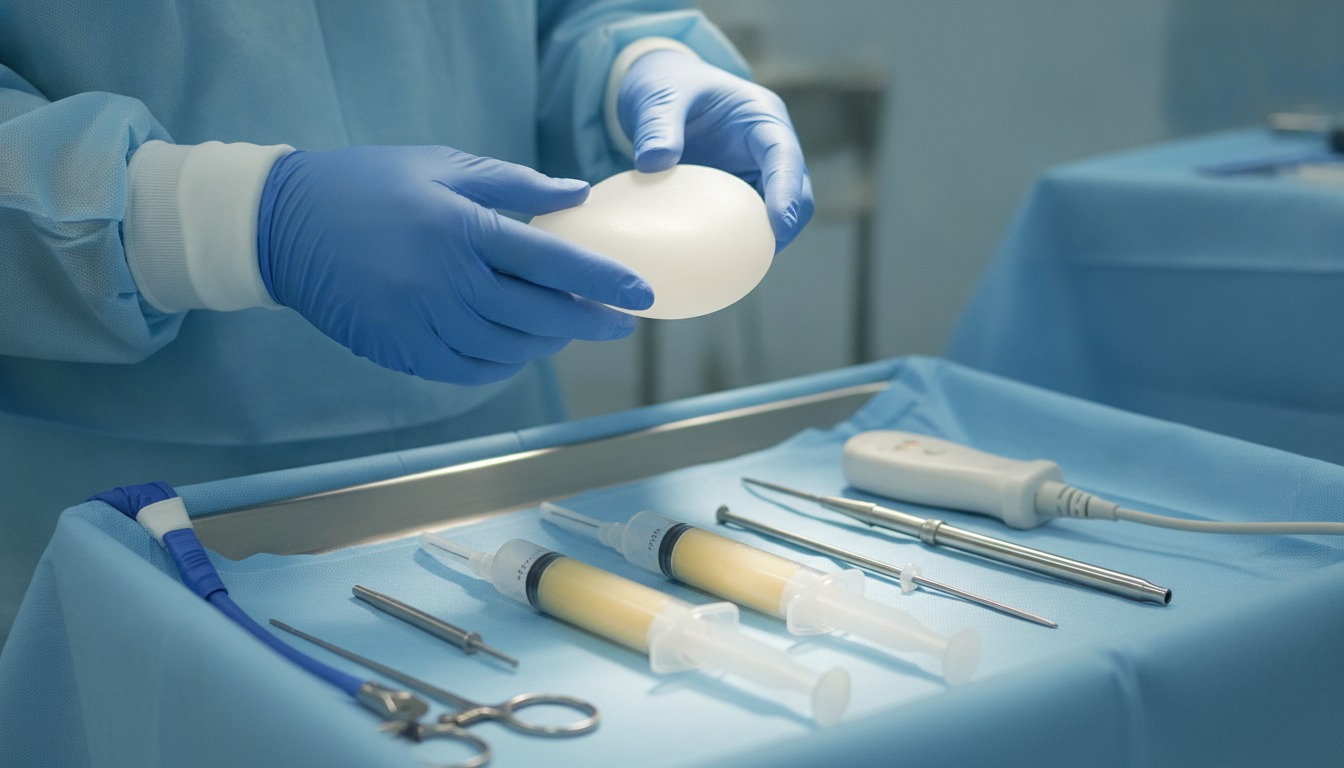
Dr. Agullo: “When the patient wants the implants out, I usually will stage it before doing the fat transfer. We can do a little bit of fat transfer at the same time, but it really depends where the implant was placed. If it was placed over the muscle, then a fat transfer will be difficult, as a lot of the fat will go into the pocket and die, becoming necrotic and forming a firm nodule. If the implant is under the muscle, then there is a good layer of fatty tissue where we can transplant the fat using the BBL method and ultrasound.
“But a lot of times, when we remove the implant, a large divot is left at the apex where the implant was, and it will require further fat transfer. Sometimes it can be done with alloClae, which is a donor fat graft. More often than not, the procedure needs to be staged.”
Fat needs living tissue on every side to survive. An empty implant pocket is the opposite of that. Graft into it and you are filling a cavity, and a cavity does not feed anything.
If you stage it, how long do you wait?
Dr. Agullo: “I usually like to wait at least three to six months before going back to do fat grafting. The main reason is we want the swelling to settle down, the implant pocket to close off, and the patient to recover physically before undergoing general anesthesia again.”
What happens to the capsule and the muscle when the implant comes out?
This is the part patients have usually read the most about, and the part other surgeons have often described to them in the most alarming terms. Here is what I told one patient in consult.
Dr. Agullo: “We remove the implant, we remove the capsule, and then the muscle just heals back together. We do have to leave a drain in that pocket so it doesn’t fill with fluid, and it just collapses and heals back in.
“On the capsule: you take as much as you need to. Sometimes the capsule is so thin that if you try to take it out you’re just damaging muscle. If it’s a thick capsule, we take it out. If the implant’s ruptured, we have to take out the entire capsule. Sometimes there is no capsule.”
She had been told by another office that the muscle would need careful, layered closure to prevent a large pocket, seroma, or hematoma.
Dr. Agullo: “I would say less than one in a thousand where you would get a seroma, because the muscle has so much vascularity it almost repairs itself in about five days. If you try to put a bunch of sutures in muscle, because there’s no fascia in the middle of the muscle, it just rips open.
“I can tell you in the buttock, in more than a thousand cases, I’ve never had a hematoma in the buttock. It just behaves different.”
Does fat survive worse in a buttock that has had an implant in it?
Dr. Agullo: “Fat survival is the same in a buttock that has had an implant, still has an implant, or has had an implant removed. We always overfill when we do a fat transfer, because we know we’re only going to get about fifty to eighty percent of the fat to survive and integrate.”
So the waiting is not about fat take. It is about giving the pocket time to become tissue again. Once it has, the graft behaves like any other fat transfer.
Why do buttock implants have such a bad reputation, and what do you tell someone considering them now?
Dr. Agullo: “I don’t think they have fallen out of favor. I think they have always had somewhat of a negative reputation. This is because many physicians place the implants over the muscle, which over time creates sagging, and you can see a double butt deformity. You can feel the implants. You can even flip them, as you can see in some YouTube videos. Using this technique, surgeons have a pretty high complication rate of infection and need for implant removal.
“Placing them inside the muscle does avoid a lot of these complications, as the muscle will keep the implant in place and it will not displace inferiorly. It will have more tissue between the implant and the skin, decreasing palpability. It is a more difficult surgery, but the few surgeons that perform it have decreased complication rates when done correctly.
“For patients considering implants, I think they are a great tool and a great procedure to increase projection. They are more reliable than fat transfer because they do not change over time, and the height that we place is going to be stable over time. It is not going to reabsorb, and it is going to push out the buttock for that projection a lot more than fat, which is soft. It is a great procedure for someone that does not have a lot of fat to donate, and we can use their fat for the hips and the implant for the projection.”
That is the whole argument in one paragraph. Most of the horror stories are about where the implant was put, not about the implant.
Who Is a Candidate for the Conversion
The patient who does best is the one whose implants are intramuscular, whose skin still has some elasticity, and who has enough fat somewhere else to donate. The patient with over-the-muscle implants, a lot of sagging, and very little body fat is usually better served by removal plus a buttock lift than by trying to rebuild volume with fat that has nowhere healthy to live.
And some patients should simply have the implants removed and stop. If what brought you in was pain, infection, or an implant you can feel and flip, getting to a clean, healed buttock is the goal. Whether to add volume later is a separate decision, made three to six months down the road when you can actually see what you have.
What the Removal Operation Is Like
From the same consult, for a patient combining removal with liposuction and a lift:
Dr. Agullo: “This would be about a four, four and a half hour surgery. Liposuction about two hours, the implant removal about an hour and a half to two hours, and then the incision and closure the rest of the time.
“Drains: usually a week, but it could be longer, it just depends how much fluid is coming out. Antibiotics: usually for a week, but we like to keep antibiotics until the drains are out. IV antibiotics go in right before surgery, then post op antibiotics, everything is sterile, and we use antibiotic irrigation to clean out the pocket after we remove the implants.
“You really don’t have to avoid sitting, because unless I do a little bit of fat injections, there’s no restriction; if I do fat, then two weeks. Compression garment for a month.”
We use Exparel, a local anesthetic that lasts about three days, and in my experience the removal is less painful than the original placement was.
What It Costs
The fat transfer stage is priced as a Brazilian butt lift, which starts at $11,500 and includes one liposuction site, with each additional site at $2,000. The removal stage is quoted individually, because how long it takes depends on where the implants are, whether they are intact, and whether a lift is being done at the same time. Current pricing is always on the fees page.
Dr. Agullo is certified by the American Board of Plastic Surgery and the American Board of Surgery, completed his plastic surgery fellowship at the Mayo Clinic, and serves as Clinical Associate Professor of Plastic Surgery at Texas Tech University Health Sciences Center. He is a founding vice president and past president of the World Association of Gluteal Surgeons and has been a Castle Connolly Top Doctor for thirteen consecutive years.
Book a Consultation
If you have buttock implants and want them out, bring your operative report if you have one. Where the implants sit decides almost everything about what comes next, and I would rather tell you that in person than have you find it out on the table.
Call (915) 590-7900, text 1-866-814-0038, or book online at agulloplasticsurgery.com. #StayBeautiful