
July 18, 2026 | Anti-Aging, Skin Care Regimen
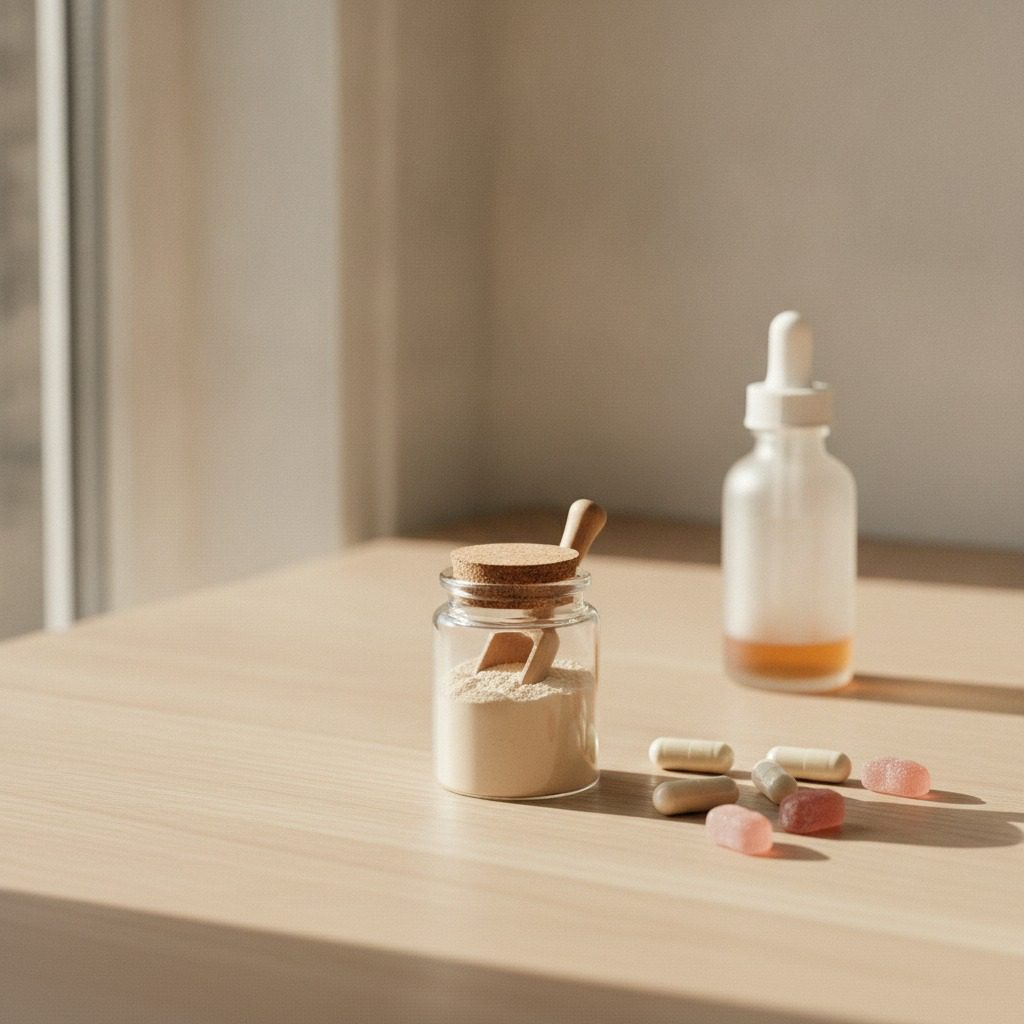
She came in a few weeks ago and dumped three things on the desk. A jar of collagen powder. A bottle of collagen capsules. And a bag of strawberry flavor collagen gummies, bought to humor her daughter who liked the taste of them.
“I have been taking all of these,” she said. “Is any of it working?”
It is a fair question, one I answer some version of weekly. This month Flow Space asked me the same thing for a story about collagen formats, so I am posting it here the way I gave it to the writer, inclusive of what she did not have room to use.
Start With What Collagen Is Doing in Your Skin
Collagen is the primary structural protein found in the dermis, the underlying layer of skin. It functions as a scaffolding that maintains the skin’s firmness and elasticity and helps prevent the formation of wrinkles.
The amount you make steadily decreases after around the mid-twenties. This is a gradual, subtle change; during most of your life it does not manifest in ways noticeable to you.
Then, for many women, it stops being gradual.
The Menopause Window
Here is the number I give almost every woman in my office who is in her late forties or fifties. In the first five years after menopause, a woman loses between 25 and 30 percent of the collagen in her skin.
Not across a lifetime. In five years.
Estrogen stimulates collagen production, so when estrogen drops, production drops with it. That is why patients describe their skin as having aged suddenly. I can see the panic when they say it. It was not sudden, it was fast, and there is a physiological reason for it.
After knowing that number, it makes sense that your supplementation goals should change. You simply cannot replace a 25 percent structural loss by eating properly, but you do have control over your existing tissue to an extent.
The Format Actually Matters
This is where patients are sometimes disappointed, because they assume all collagen is basically the same. It really is not. It matters how it is delivered, and whether that delivery can approximate the conditions studied in the research.
Powder is the format with real human evidence. Clinical trials have often made use of doses spanning from 2.5 to 10 grams of hydrolyzed collagen peptides daily, and they have revealed minor increases in both skin hydration and elasticity after 8 to 12 weeks. The word minor adequately summarizes the degree of effect witnessed. Yet these effects were observable and measured in actual people, an achievement not met by a significant proportion of the offerings in this segment.
Powder has the other advantage that a scoop yields the dose the study used, so you can actually take exactly what was studied.
Capsules struggle with dose. Peptides do not have a dose problem; volume does. Reaching even the low end of the tested dosage means swallowing a lot of capsules every day, every day of the year. Most will take two capsules and call it good enough, getting a small fraction of the tested dose. If capsules are the only way for you to stick to it, look at the label and get the real dose instead.
Gummies are the weakest option. I know they are the easiest to remember, but most of them are not good. They typically contain a lot of added sugar, which can damage collagen, and they are low in collagen to begin with. Sugar molecules in the bloodstream eventually glycate proteins by attaching themselves. Collagen is one example, and glycation makes it brittle and less elastic.
No point in a supplement that provides negligible collagen while damaging what you already have.
| Format | Delivers the studied dose | Main limitation | Worth it? |
|---|---|---|---|
| Powder | Yes | Requires mixing, taste varies | Yes, this is the one |
| Capsule | Only at high pill counts | Underdosing is common | Only if you take enough |
| Gummy | No | Low content plus added sugar | I would skip it |
| Serum | Does not apply | Cannot reach the dermis | It is a moisturizer |
Why a Collagen Serum Cannot Do What the Label Suggests
People think the path is direct. If you smear collagen onto the skin, it sinks in through the epidermis and down to the dermis.
It does not, since collagen is far too large for your stratum corneum, the outer barrier layer, to let it pass. The door of your top skin barrier remains closed, with serums resting on the skin to encourage hydration and nothing else getting in.
That is why you look plumper and smoother after using one. It is not a change to structure. You are adding water, which you retain superficially and also temporarily.
To get a topical with the aim of boosting your own collagen production, look to retinoids, a good vitamin C serum, and certain peptides. They are the ones telling your fibroblasts it is time to start manufacturing collagen. If there is “collagen” slapped on the front of the label, it just means they put some collagen into the formulation. It does not signify that it helps your skin create more.
The Habit That Beats Every Supplement
If you change only one thing after reading this, change this one.
Ultraviolet light contributes most to collagen loss, and it works both ways at once. UV rays activate enzymes that degrade existing collagen and they slow down its renewal. This would probably be an interesting piece of trivia for anyone not stuck in a sunnier-than-average climate most of the year, but living in El Paso means the sun is the number one culprit behind how skin ages here.
Your day-to-day sunscreen actually does more for collagen protection than any supplement on the planet.
Then a retinoid nightly. In the morning, vitamin C. Sufficient protein to build things up properly. Good sleep. Fewer processed sugary foods. Not some secret bullet list of answers to the mysteries of life. Just where the science points. So far, all of it works.
When a Supplement Is Not Enough
Most of what people ask of their collagen is something a powder simply cannot do. Better to tell them now than let them spend another quarter on false hope.
For true collagen production you need something that stimulates the dermis directly, such as Sculptra, which encourages the body to produce new collagen over the course of a few months. Microneedling, and specifically radiofrequency microneedling which reaches deeper, produces small wounds that prompt your body into starting production. Resurfacing lasers address the surface and subsurface layers.
When sagging comes into play, no topical and no nutrient cuts it anymore. That is a structural problem, and it needs a structural answer.
I trained in plastic surgery at the Mayo Clinic, I am certified by both the American Board of Plastic Surgery and the American Board of Surgery, and I serve as Clinical Associate Professor at Texas Tech University Health Sciences Center, Paul L. Foster School of Medicine. Part of that role includes candidly telling patients when a supplement may assist their goal and when it simply is not the tool for what they want.
What I Told My Patient
Take your powder every day and give it three months before you make any decision about staying with it.
Let us tuck the pills into the drawer. As for the gummies, I asked her to put them on pause because I want to minimize added sugar, and I explained the reasoning so it did not look like a random demand.
Next, I asked what sunscreen she was wearing, since that was a far more important factor to me than whatever the bag she had dumped on my desk contained.
Collagen is a nudge, not a lift. It is not a facelift in a scoop. But it is worth something, and knowing which version is worth something is most of the puzzle. #StayBeautiful
My comments on this appeared in Flow Space, “Powders, Serums, Gummies. What’s the Best Way to Get Your Collagen?” by Maggie Ryan, July 16, 2026. For the surgeon-to-surgeon version of this post, see the companion on drworldwide.com.
Ready to Talk?
Wondering whether your skin needs a supplement, a treatment, or something more? We will sort that out as we look together.
Call (915) 590-7900, text 1-866-814-0038, or book online at agulloplasticsurgery.com.
@RealDrWorldWide on Instagram, TikTok, and Snapchat, @Agullo on X, or @AgulloPlasticSurgery on Facebook.