June 23, 2026 | Breast Augmentation Revision, Breast Implants
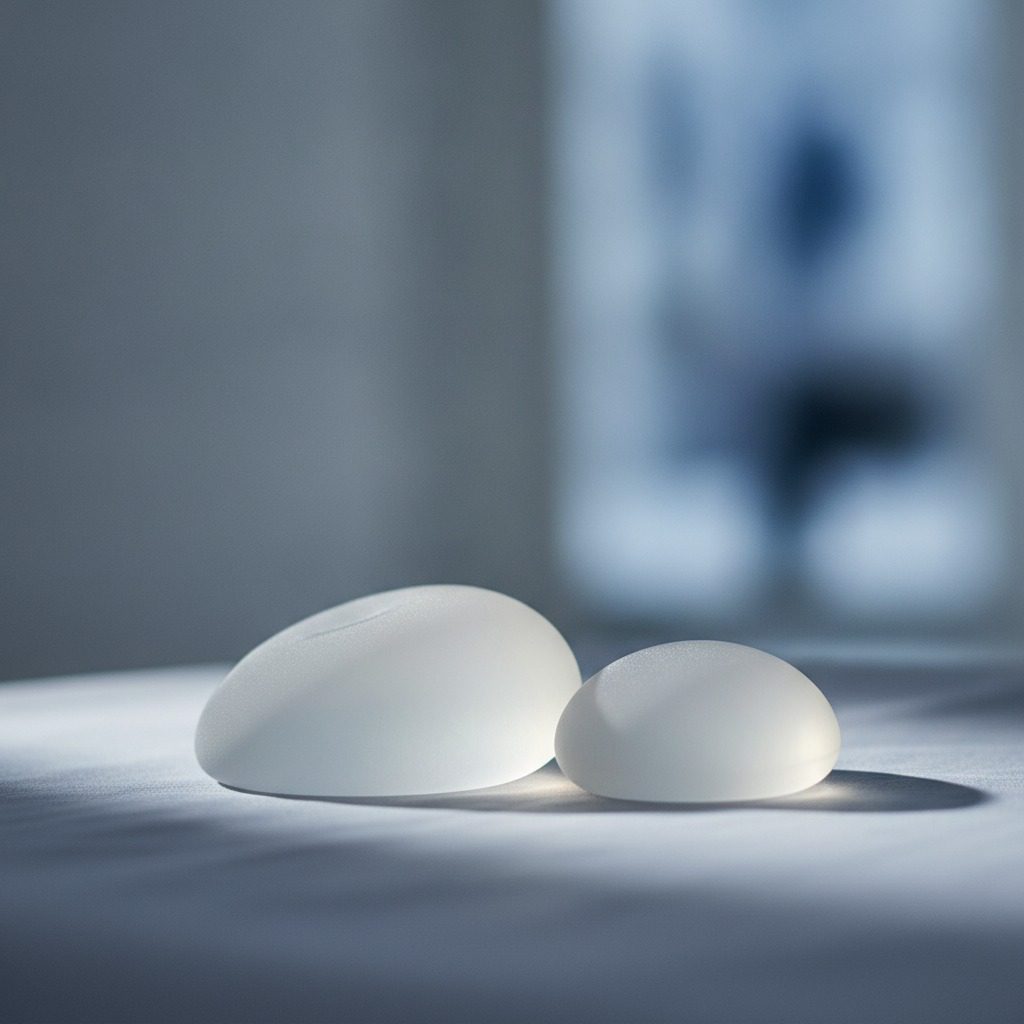
A patient sat down across from me having had her augmentation somewhere else years ago. She put it plainly. One breast was riding high, it felt firmer than it used to, and she could not tell whether she was imagining it. She was not.
A good part of my practice is revision surgery, and the questions below are the ones I answer most often, pulled from real consultations and anonymized.
“One Side Feels High and Hard, Like a Lump. What Is That?”
That is usually a capsular contracture. Whenever we place an implant, the body forms a capsule of scar tissue around it. That is normal, and it is actually helpful, because it holds the implant in position.
Sometimes, though, that capsule tightens and hardens around the implant, driven by inflammation or an old low-grade infection. It pulls the implant high and makes the breast feel firm. When it is severe, it can hurt, so if you have no pain, that is a good sign. It surprises people, but this can happen long after the original surgery.
“How Do You Fix a Capsular Contracture?”
I go in, remove the hardened capsule, take out the old implant, and place a new one. When I do that and switch you to a Motiva implant, the risk of it happening again drops below one percent.
To lower that risk even further, I often place a mesh, an internal bra layer of support, over the area. With that combination, recurrence approaches zero. And if you want to change size while we are there, we usually can, through the same incision.
“My Implants Are Old. Should I Just Swap Them?”
If you are at the ten-year mark with older-generation implants, an exchange is reasonable, and it is a good moment to reassess size and position too. I often recommend moving from an older implant to a Motiva, which lasts much longer and carries much less risk of contracture.
“I Have Had Several Breast Surgeries Already. Is It Too Late?”
No. I see patients whose first surgery was decades ago with several operations since. More history does not mean nothing can be done. It means I plan carefully and stay honest with you about what is realistic.
“Do I Need Imaging Before You Operate?”
Often, yes. If you are feeling a change, an ultrasound or MRI helps me confirm whether the implants are intact and whether what you are feeling is a contracture, scar, or something that needs more attention. I review your imaging before we make a plan. A firm, high, or newly asymmetric implant, especially a change that happened over a few weeks, is worth coming in for.
“Why Does Switching to Motiva Make Such a Difference?”
It comes down to the surface of the implant. The Motiva implants I use have a nano-surface called SmoothSilk, which provokes the lowest inflammatory response of any implant I know of. Capsular contracture is, at its root, an inflammatory problem. The capsule hardens because the body is reacting to the implant over time. When the implant provokes very little reaction, the capsule that forms stays soft and thin. That is the mechanism behind dropping the recurrence risk below one percent, and it is why I rarely reach for an older-generation implant in a revision.
These implants are also soft, the gummy bear type, and they move with your body and take on a natural teardrop shape when you stand. So a revision is often a chance to end up with a better result than the original, not just a repair of the problem.
“Will the New Scar Be in the Same Place?”
Usually, yes. In most revisions I can work through your existing incision, whether that was in the fold under the breast or around the areola, so you are not trading one scar for two. Changing size, removing the capsule, and placing the new implant can all happen through that single access point. If your old incision was poorly placed or healed badly, I will talk with you about the trade-offs of moving it before we decide.
“How Long Is Recovery From a Revision?”
It varies more than a first-time augmentation, because what we do inside is more involved. A straightforward implant exchange recovers quickly, often within a week of feeling close to normal. A full capsule removal with mesh support is a bigger operation and asks for a more careful few weeks. I will give you a realistic timeline once I have examined you and seen your imaging, rather than a generic promise.
“Can We Address More Than Just the Implants?”
Frequently, yes. If the breast itself has dropped, a breast lift can be combined with the revision. If you want to refine your waistline, we can add liposuction and use J-Plasma to tighten the skin in the same setting, so it is one recovery instead of two.
Why I Do This Carefully
I am a double board-certified plastic surgeon, certified by the American Board of Plastic Surgery and the American Board of Surgery, with a plastic surgery fellowship at the Mayo Clinic, and I have been a Castle Connolly Top Doctor for thirteen consecutive years. Revision surgery is harder than a first-time augmentation, because the tissue planes are already disturbed. That is exactly why it should be planned, not rushed, and why I want to examine you and review your imaging before promising anything.
See the Other Versions
For the surgeon’s editorial take on reading these problems, see the companion essay on drworldwide.com. For the practice overview, see the version on swplasticsurgery.com.
Ready to Talk?
If something feels high, hard, or out of place, do not sit on it. Bring any prior records you have and come let me take a look.
Call the office at (915) 590-7900, text 1-866-814-0038, or book online at agulloplasticsurgery.com. #StayBeautiful.
@RealDrWorldWide on Instagram, TikTok, and Snapchat, @Agullo on X, or @AgulloPlasticSurgery on Facebook.