June 19, 2026 | Plastic Surgery News, Scar Healing
A patient sat down across from me last week with a photograph of her three-year-old C-section scar in one hand and a question on her face. Why did her sister, who delivered both of her children at the same hospital, two years apart from hers, end up with two scars that looked like a fine pencil line drawn across the abdomen, while my patient’s scar was raised, pink, and tender every time she put on a fitted shirt.
The answer is usually more than one thing. Genetics matters. Skin type matters. The location and tension of the incision matter. The surgical technique matters. But one variable in that equation gets discussed almost never, and it is the one I want to discuss today, because a clinical study I served as a principal investigator on, published as a trade industry feature in early 2025, put a hard number on it.
The variable is the blade itself.
The 114-Patient Study and What It Showed
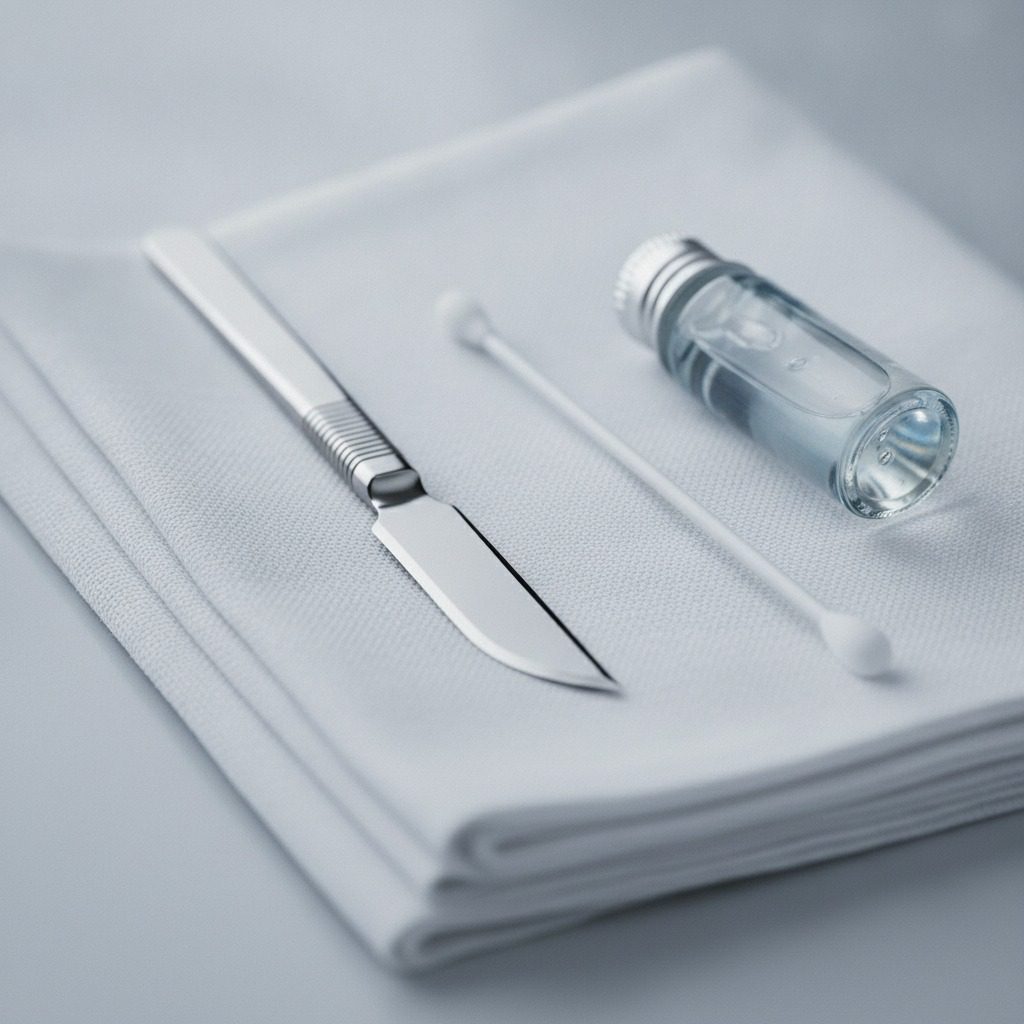
I served as a principal investigator alongside Michael Sanchez, PhD on a 114-patient clinical study evaluating the Planatome surgical blade. Planatome blades are manufactured with a polishing process that produces a smoother, sharper cutting edge than a standard surgical blade. The hypothesis was straightforward. A cleaner cut, with less micro-trauma to the adjacent tissue at the edges of the incision, should produce a quieter inflammatory response, and a quieter inflammatory response should produce a finer scar.
The study followed patients through standardized plastic surgery incisions and assessed scar quality at multiple time points. The headline finding was a measurable reduction in hypertrophic scarring in the Planatome arm. The trade industry coverage that picked the study up called it a significant reduction.
The study did not claim that blade quality is the only variable in scar formation. It did show that, holding other variables steady, the edge of the blade itself moves the needle on the final scar.
Why Blade Geometry Matters Before the First Cut Closes
The wound healing cascade begins the moment the blade enters the skin. The cleaner the cut, the narrower the zone of cells along the incision edge that get crushed, sheared, or partially devitalized rather than cleanly transected. That zone of marginal-cell damage is one of the largest single inputs into the inflammatory response that follows.
A standard surgical blade, even a brand new one straight out of the package, has microscopic irregularities along the cutting edge. Under a high-magnification image, those irregularities tear the tissue along the incision in a way that is functionally invisible to the surgeon at the time but biologically meaningful at the cellular level. The cells along the incision edge respond not to the surgeon’s intent but to the cellular environment they are actually in.
A polished, sharper edge produces a different cellular environment. The cells along the incision are cleanly transected rather than crushed. The inflammatory cascade is quieter. The fibroblast recruitment, the collagen deposition, and the final remodeling that produces the mature scar all play out on a different starting point.
In a hypertrophic-scar-prone patient, the starting point matters disproportionately. The patient who would have formed a flat, fine scar under almost any technique will form a flat, fine scar regardless of the blade. The patient who would have formed a raised, thickened, hypertrophic scar under any technique benefits, in the data, from a quieter cellular environment at the moment of the cut.
The Other Variables in the Scar Equation
The blade is one input. The honest version of this conversation also includes the others.
Genetics and skin type. Patients with a Fitzpatrick IV to VI skin type, patients with a personal or family history of keloid scarring, and patients of certain ancestries are at elevated risk for hypertrophic scarring regardless of any other variable. Honest pre-operative counseling sets expectations accordingly.
Anatomic location. Scars across the sternum, across the deltoid, and across the upper back have a higher rate of hypertrophic transformation than scars in the inframammary fold, the suprapubic crease, or the periareolar location. Where the cut goes matters as much as what cuts it.
Tension. A scar closed under tension forms wider and thicker than a scar closed under neutral tension. The placement of the incision, the planning of the resection, and the layered closure all contribute to the final tension on the scar line.
Closure technique. Layered closure with deep-dermal sutures that take the tension off the skin layer, fine subcuticular sutures that approximate the dermal edges without strangulating them, and meticulous wound edge eversion all contribute to scar quality.
Post-operative scar care. Silicone gel sheeting, compression, sun protection, and in selected cases laser or microneedling at the appropriate post-operative interval all influence the final scar.
The blade is the input the surgeon controls at the very first moment. The closure is the input the surgeon controls at the very last moment. Both moments matter.
How I Use the Findings in My Practice
I incorporate the Planatome blade into the operations where scar quality is most consequential to the patient, including breast augmentation, tummy tuck, mommy makeover, facelift, and any procedure on a hypertrophic-scar-prone patient. The blade is one decision in a longer chain of decisions designed to optimize the final scar.
I also use the data from the study at the consultation. When a patient asks, as my Wednesday patient did, whether anything can be done to give her the cleanest possible scar from a planned operation, I can answer with a study I helped design rather than a vague reassurance. The conversation goes from “I will do my best” to “Here is what the literature says about the variables I can control.”
A Comparison That Sets Expectations Honestly
| Variable | Surgeon Controls | Patient Controls | Effect on Scar |
|---|---|---|---|
| Blade quality | Yes | No | Measurable in the Planatome study |
| Incision location | Yes | No | Large |
| Tension at closure | Yes | No | Large |
| Closure technique | Yes | No | Large |
| Genetics and skin type | No | No | Large |
| Anatomic location risk | Partial | No | Moderate |
| Post-op silicone, compression, sun protection | Plan only | Yes | Moderate |
| Post-op laser, microneedling on indication | Yes | Partial | Moderate |
| Activity restrictions | Partial | Yes | Small to moderate |
The table is honest about what each party brings to the final scar. The blade is one row. The other rows still have to be done correctly.
The Limits of a Single Study
A 114-patient study is a meaningful contribution. It is not the last word. The findings need to be replicated by other investigators, on other patient populations, in other operations, before the field as a whole adopts a position. The trade industry coverage in MPO Magazine framed the result as significant, and I would agree. I would also say that the most useful framing for a patient is that blade geometry is one of the variables that shapes the final scar, and that I, as a surgeon, prefer to control as many of those variables as I can.
How I Talk About Scarring at the Consult
When a patient asks about scarring at a consultation, the conversation runs in roughly this order. First, the realistic expectation for her skin type and her planned incision. Second, the specific design of the incision, including the location, the orientation, and the length. Third, the closure plan, including the layers and the suture choice. Fourth, the blade. Fifth, the post-operative scar-care plan. Sixth, the contingency plan if the scar does not behave the way we hope.
The conversation is honest. The variables are real. The starting point matters, and it starts at the edge of the blade.
Why Choose Dr. Agullo
Double board-certified, American Board of Plastic Surgery and American Board of Surgery. American College of Surgeons Fellow. Mayo Clinic plastic surgery fellowship. Clinical Associate Professor of Plastic Surgery at Texas Tech University Health Sciences Center Paul L. Foster School of Medicine. Affiliate Professor at UTEP. Castle Connolly Top Doctor for thirteen consecutive years. Principal Investigator on the 114-patient Planatome surgical-blade clinical study. A consultation in my office includes an honest read on your scar risk, an honest plan to address it, and a serious commitment to controlling every variable a surgeon can control before the first cut closes.
Ready to Talk?
If you are weighing an operation that will leave a scar, the first conversation is a consultation. We will discuss the operation, the planned incision, the closure plan, and the scar-care plan in detail. If you have a previous scar that did not behave the way you hoped, we will discuss what can be done about it.
For the surgeon’s editorial take on the same topic, see A Sharper Edge: A Surgeon’s Read on Blade Geometry and Scarring on drworldwide.com. For the practice-program version that lays out the scar-management continuum, see The Scar Management Program at Southwest Plastic Surgery.
Call (915) 590-7900, text 1-866-814-0038, or book online at agulloplasticsurgery.com. #StayBeautiful.
@RealDrWorldWide on Instagram, TikTok, and Snapchat, @Agullo on X, or @AgulloPlasticSurgery on Facebook.