July 29, 2026 | Scar Healing, Techniques
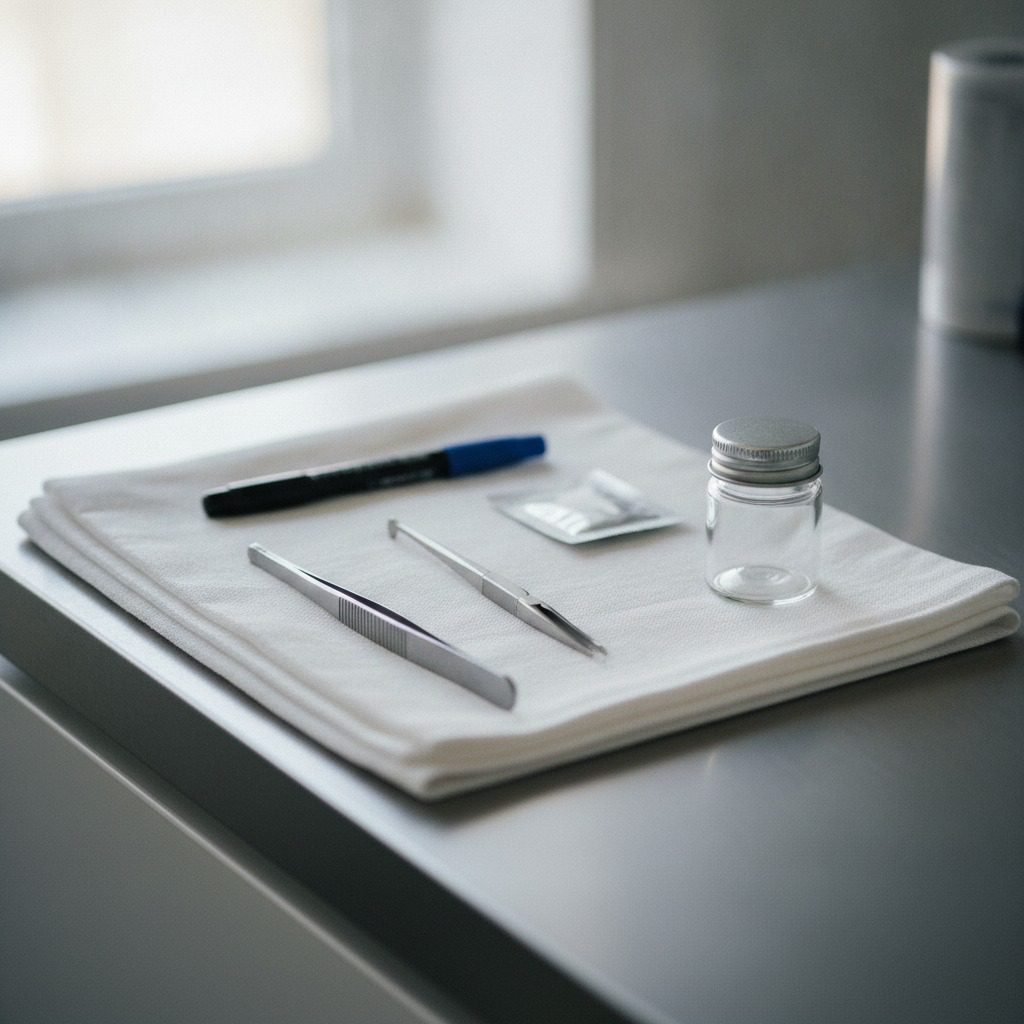
A patient rolled up her sleeve in my exam room last month and showed me a soft lump on her forearm that she had been covering with long sleeves for six years. Her primary doctor had told her twice it was nothing. She believed him. She still wanted it gone.
That visit took less than an hour, start to finish, including the removal.
Many people do not realize that a plastic surgeon removes lumps, bumps, and skin lesions in the office, under local anesthesia, without involving an insurance company at all. It is one of the quietest and most satisfying parts of my practice. Here is how it works.
What We Remove Most Often
One of the most common minor procedures we do is excision of moles. These are usually on the face, but they can be anywhere in the body. It’s a pretty simple procedure. Most patients are self-aware of these moles. Some moles can be beautiful, and some patients simply don’t like theirs. Both are valid reasons to be in my chair.
Something that’s very common as well is an inclusion cyst. These are usually sebaceous cysts, where a hair follicle has been clogged, and the follicle continues to create the oil for the skin. This turns into sebum (the thick material the gland produces), which continues to grow. The biggest risk here is that it could get infected. If you don’t remove the root of the cyst, then it usually comes back, which is why draining a cyst is a temporary fix and excision is the definitive one.
And then lipomas are actually very common as well. These are just fat cells that have gone haywire and continue to grow and create a contour deformity on the skin, a visible bump where the surface should be smooth. These are usually benign.
Skin tags round out the list: small, hanging growths that catch on necklaces, collars, and seat belts. They come off quickly, often several in one visit.
Local Anesthesia, Sedation, or General
Most lesions, including cysts, lipomas, skin tags, and moles, can be excised under local anesthesia. You are awake, the area is numb, and you drive yourself home.
The only exception is when these are larger than usual, and the patient may not be comfortable, or they may be anxious about the procedure. That’s when we recommend IV sedation. It is rare to have to do general anesthesia for these procedures, but it is possible. Sometimes we use it for small children, because they’re not able to stay still for the procedure itself.
Why a Plastic Surgeon Instead of a Walk-In Clinic
A lot of patients come to see a plastic surgeon like myself because they know that we are more aware of how to make incisions heal the best way possible, avoiding thick or raised scars.
As plastic surgeons, we usually do a layered closure of the incisions, which means we approximate the deep layer, the intermediate layer, and the skin level, so that there’s really no tension on the incision itself, and we get the best possible scarring. Tension is what makes scars wide. Remove the tension and you change the outcome.
The care does not stop at the stitching. Follow-up treatments include taping, silicone sheeting, and scar creams like Skinuva. For certain patients at certain points we add steroid injections, laser treatments, or microneedling to refine the result further.
I am a double board-certified plastic surgeon, certified by the American Board of Plastic Surgery and the American Board of Surgery, and I completed my plastic surgery fellowship at the Mayo Clinic. The same closure principles I use on a body contouring incision apply to a one-centimeter mole excision on the cheek.
Cash Based, No Insurance, and Why Patients Prefer It
This service line is cash based. We do not bill insurance for these excisions, and that is a feature, not a limitation.
The biggest advantage is that there’s no need to preauthorize with the insurance, which can take time and effort. Once we have a consultation, and often this can be done via email, virtually, or in person, you get a quote which includes the entire treatment, with the scar management products as well as pathology if it’s necessary. Instead of dealing with insurance, where you have to use a surgeon that’s within the insurance plan, in this case you’re free to have surgery with me.
The rough price range for an excision is usually around one thousand dollars, but it could be from five hundred dollars and up, depending on the size and number of lesions, tumors, or skin tags that we’re removing.
The Pathology Step
If there’s any suspicion that the lesion or the mass may be malignant, or we want to rule that out for peace of mind, we send these to the pathologist. The pathologist can be paid through insurance, or it can be included in the package. We usually get results within three to five days.
One warning I give patients about waiting on a cyst: a lot of doctors may say this is not an emergency, it’s not really medically necessary. Well, if the cyst ends up getting infected, it becomes an emergency. You usually have to go to the emergency department and get it drained, and get on antibiotics. Sometimes you have to be admitted, because the infection may have spread. Something very simple that can be treated early can prevent a major complication. I always recommend excising the inclusion cyst all the way down to the root.
Recovery and What the Scar Does Over a Year
These procedures are usually pretty straightforward, and recovery is easy. Most patients return to work the next day with light duties. We usually wait a couple of weeks before starting any exercise. If there are any sutures, these are removed in seven to ten days.
The scar itself continues to get better and better, reaching its final result in about a year. Early on it may be a little bit red and a little raised, and this continues to improve with the scar management protocol.
Why Choose Dr. Agullo
Double board certified. Mayo Clinic fellowship trained. Clinical Associate Professor of Plastic Surgery at Texas Tech University Health Sciences Center. Castle Connolly Top Doctor thirteen consecutive years. And a closure philosophy that treats a small excision with the same respect as a full surgical case.
Ready to Talk?
If you have a mole, cyst, lipoma, or skin tag you want gone, send a photo and we can often quote it virtually. Call (915) 590-7900, text 1-866-814-0038, or book a consultation online. #StayBeautiful
@RealDrWorldWide on Instagram, TikTok, and Snapchat, @Agullo on X, or @AgulloPlasticSurgery on Facebook.
Companion reads: the editorial version of this argument on drworldwide.com, and the practice-side overview with scar aftercare options at swplasticsurgery.com.