May 13, 2026 | Breast Augmentation
A young patient came into my consult room last fall with a goal that was easy to articulate and harder to execute. She wanted breasts that fit her frame. She did not want anything that looked done. She did not want to spend six weeks off her CrossFit programming. She lifted four times a week, ran twice, and held a job that did not give her two weeks of sick leave without explanation.
The standard breast augmentation conversation I had been having with patients like her for fifteen years involved a series of compromises. Smaller implants to preserve a natural look. Submuscular placement to keep the upper pole soft. A six-week return-to-activity timeline because the pectoralis muscle had been lifted, and the body wanted that time. The trade-offs felt necessary, because the alternative was either a result that looked obvious or a recovery that took her out of the gym for too long.
In the last twelve months, I have stopped having that conversation. The reason is a technique called Motiva Preservé, and what changed in my operating room is real enough that I want to walk you through it.
What Motiva Preservé Actually Is
Motiva Preservé is a preservation-focused surgical technique built around the Motiva Ergonomix implant. The technique was developed and is taught by Motiva (a division of Establishment Labs), the company that earned FDA approval for its silicone gel implants in 2024 after years of leading the implant market in Latin America and Europe.
The “preservation” in the name is not marketing copy. It refers to a specific commitment in the operating room. Smaller incision. Minimal dissection. The breast tissue, the muscle attachments, the lymphatic and neural anatomy left as close to its native state as the procedure allows. The implant goes through a 2.5 to 3 centimeter incision in the inframammary fold (the natural shadow under the breast), into a pocket that has been opened with as little tissue trauma as possible, often using a no-touch funnel to keep the implant from contacting skin on the way into the pocket.
What patients feel afterward is the part that matters. Less swelling. Less tightness. Less of the bruised-rib soreness that defines the first week of a traditional submuscular augmentation. My Preservé patients describe the first day after surgery the way patients a decade ago described the third or fourth week.
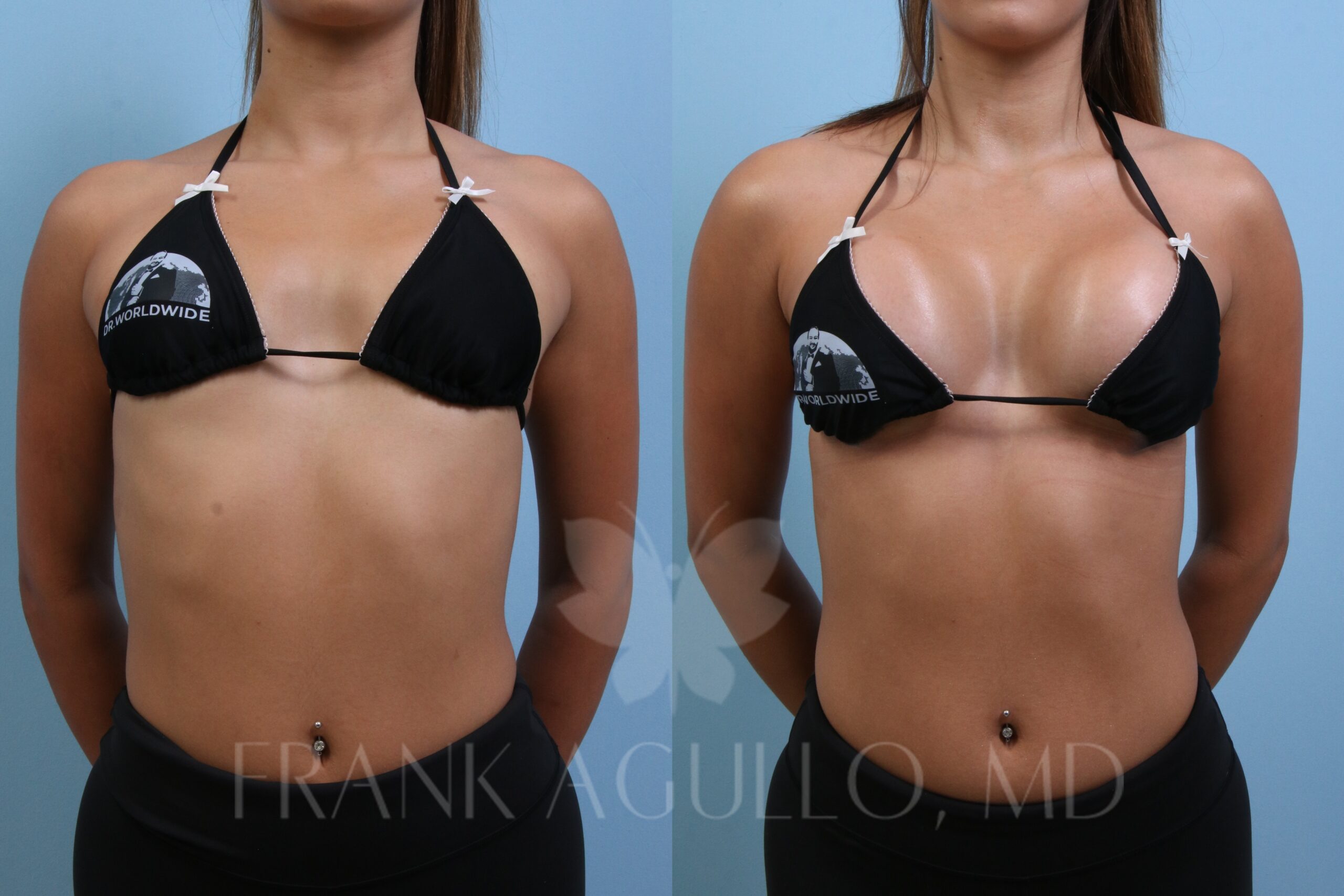
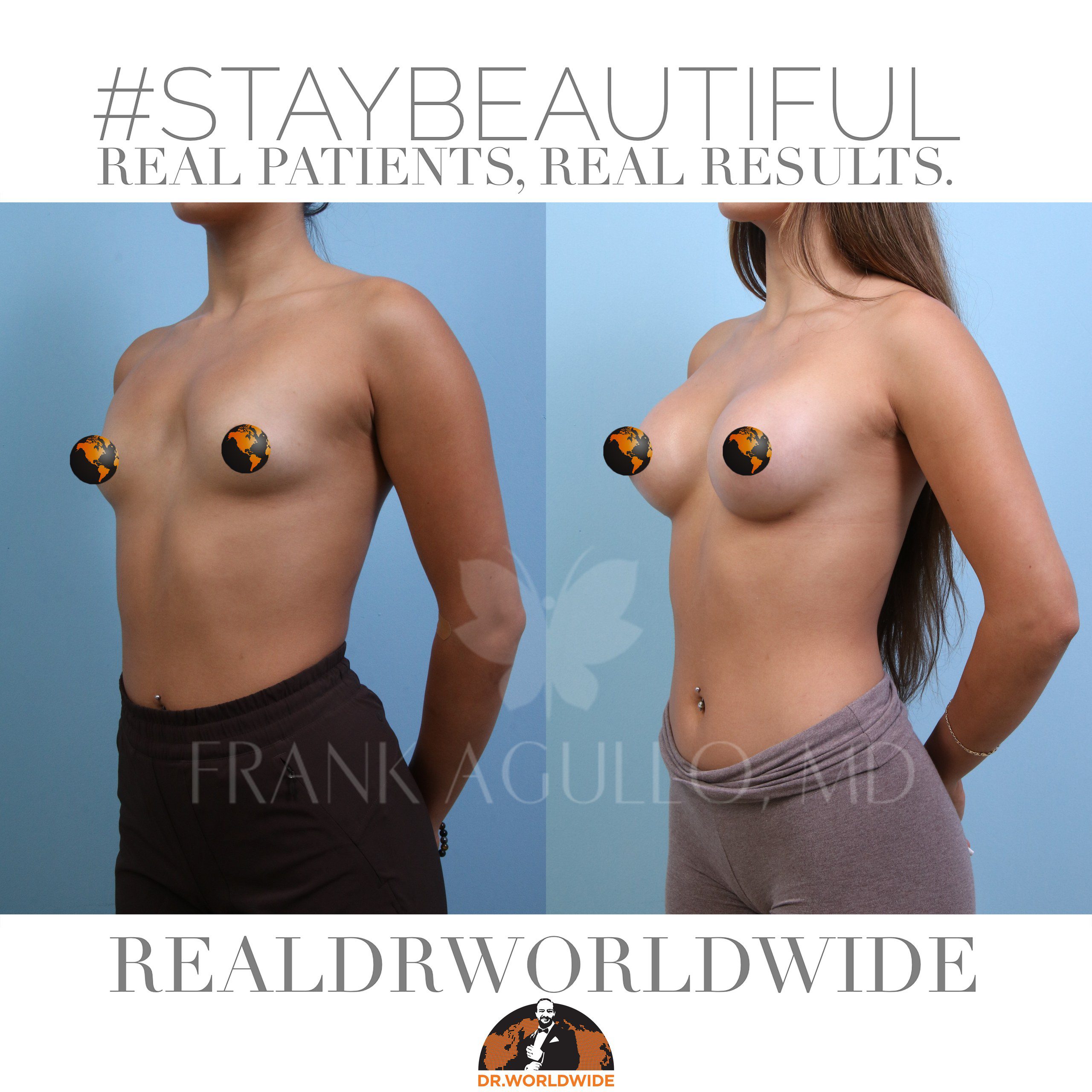
The case in the photos on this page was performed under light sedation (rather than general anesthesia) in our accredited surgical suite, and the operation itself was completed in under an hour. The patient was discharged the same morning. The shorter anesthetic exposure is part of the reason the recovery profile compresses so dramatically.
The Implant: Motiva Ergonomix Full at 315cc
The Motiva Ergonomix is a sixth-generation silicone gel implant designed to behave more like breast tissue than any implant I have placed before. The gel inside is ProgressiveGel Ultima. The shell uses TrueMonobloc construction with a SmoothSilk surface that has been shown in published data to lower the rate of capsular contracture compared to older textured surfaces.
The shape is the more interesting piece. The Ergonomix is described as ergonomic, meaning it changes shape with body position. Upright, it takes on a teardrop drape that looks like natural anatomy. Supine, on the back, it flattens and rounds the way real breast tissue does. There is no fixed shape locked into the device, which is what gives Motiva patients the natural-movement aesthetic that has been driving the brand’s reputation worldwide.
The Full profile is one of three Ergonomix projection options Motiva offers in the United States (Mini, Demi, and Full). For a slim athletic patient who wants visible projection but a natural silhouette, Full sits at the upper end of the range. The full implant catalog and our practice’s adoption notes live on the Motiva breast implants page and the Motiva Preservé breast augmentation page.
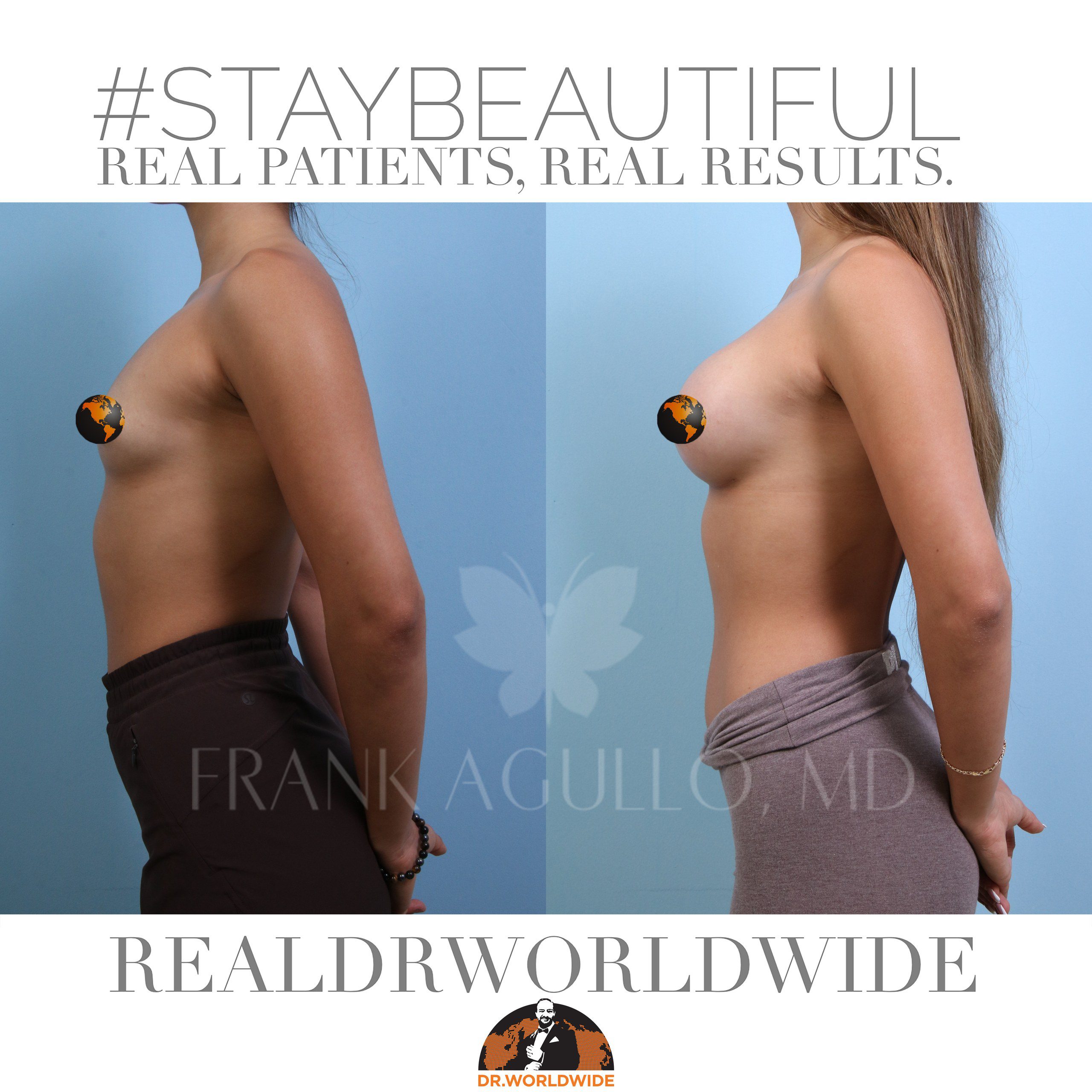
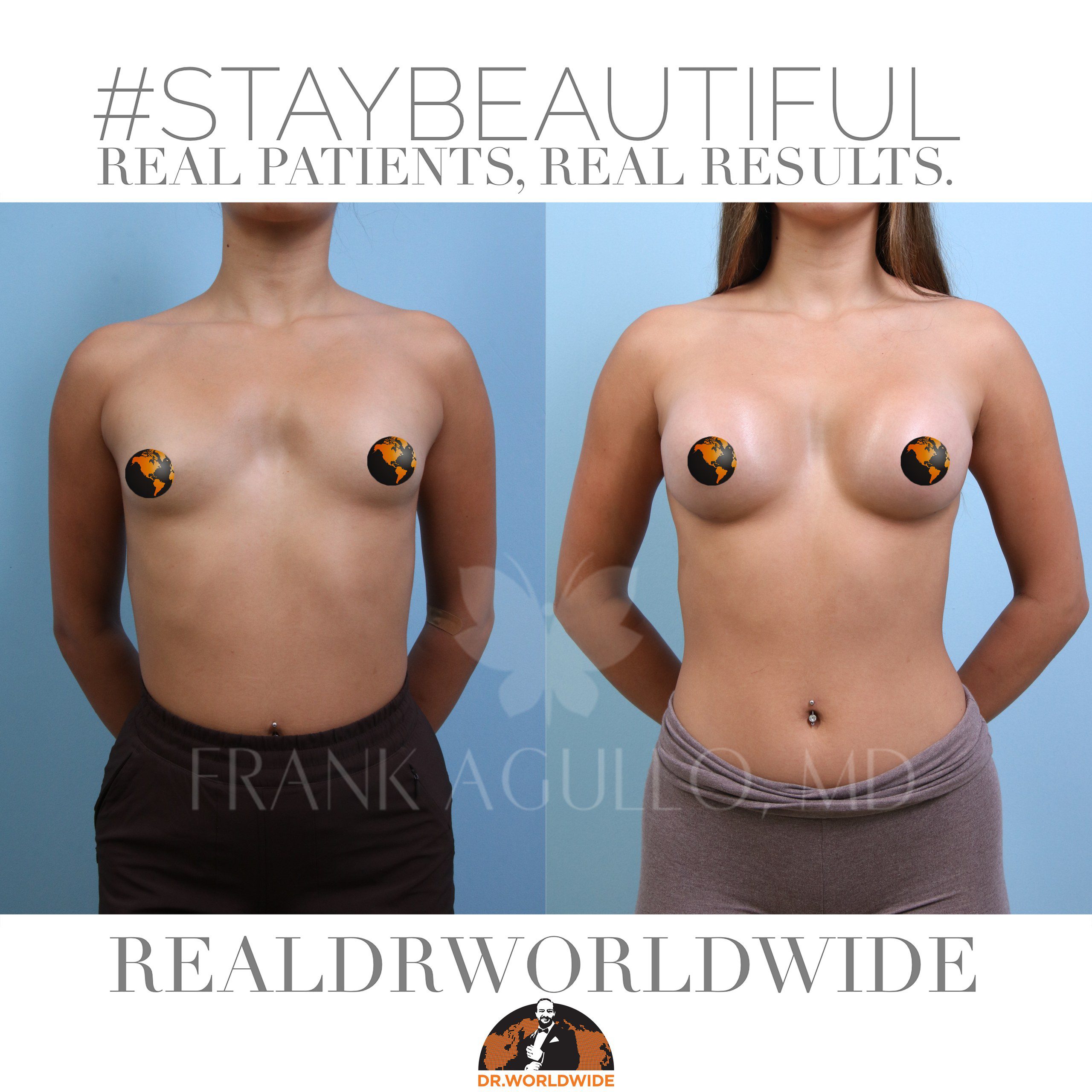
The 315cc size, on this patient, was the result of pre-operative sizing in the office and a long conversation about goals. She did not want a striking change. She wanted proportion. The before and after images at the top of this post show what 315cc looks like on her frame.
Why “Back to Work the Next Day” Is Not a Marketing Line
The single hardest number to defend in breast augmentation is recovery time. For decades, the honest answer to “when can I lift my kids” was four to six weeks. The honest answer to “when can I lift heavy at the gym” was six to eight. Those numbers reflected the trauma of a traditional submuscular augmentation, where the pectoralis major is partially released to make room for the implant. That release heals. It just takes time.
Preservé changes the math by changing what gets dissected in the first place. No muscle release at all, because the implant sits in front of the muscle. Less tissue handling. Smaller incision. A 24-hour recovery protocol that includes a long-acting local anesthetic and a structured return-to-activity ladder.
The patient in the photos on this page went back to her desk job the day after surgery. She was lifting weights at two weeks. She was running, with a sports bra and no chest strap, at four. None of those numbers came from the manufacturer’s marketing deck. They came from her own logbook, which I reviewed before writing this post. The compression bra came off at three weeks. The implant was settled into its final pocket position by week six.
That is the recovery profile I am promising the next patient who walks in with the same question.
Where Preservé Sits Next to a Traditional Submuscular Augmentation
Patients who have done their homework arrive in my office already familiar with the standard playbook. Saline or silicone. Round or shaped. Submuscular, subglandular, or dual-plane. They have heard of textured and smooth surfaces. They have seen the warnings about ALCL. They want to know where preservation fits in that vocabulary.
| Question | Traditional Submuscular Augmentation | Motiva Preservé |
|---|---|---|
| Implant placement | Behind the pectoralis muscle | In front of the muscle (prepectoral), held by natural ligaments, no muscle release |
| Incision length | 4 to 5 cm | 2.5 to 3 cm |
| Implant insertion | Direct hand placement | No-touch funnel preferred |
| Return to desk work | 5 to 7 days | 1 to 2 days |
| Return to lower-body gym | 3 to 4 weeks | 7 to 10 days |
| Return to chest and upper-body lifting | 6 to 8 weeks | 2 to 3 weeks |
| Compression bra worn | 4 to 6 weeks | 2 to 3 weeks |
| Implant surface | Smooth or textured (varies) | SmoothSilk |
| Implant shape behavior | Fixed (round or shaped) | Ergonomic, position-responsive |
| Visual result | Can read fuller or more obvious | Designed to read as natural anatomy |
The table does not capture everything that matters. The technique is more demanding than a standard submuscular augmentation, and the surgeon’s volume with the specific Motiva system matters. I trained on it directly before I placed an implant in a patient. I do not place a Motiva implant the way I place every other implant in my OR, because the technique is different and the implant rewards the difference.
Who Is the Right Candidate
The slim athletic patient profile shown in the photos at the top of this post is one of the easier candidates to plan a Preservé case for. Adequate skin envelope. Defined inframammary fold. Tissue that responds well to a preservation-focused dissection. Goals that lean toward proportion rather than dramatic enlargement.
Patients who fall outside that ideal envelope can still be excellent candidates with the right technique modifications. A patient with loose tissue may need a breast lift in addition to the augmentation. A patient with significant asymmetry may need different volumes on each side, or different profiles. A patient with a history of prior augmentations and capsule issues needs a more nuanced breast augmentation revision conversation. Preservé is not a one-size-fits-all replacement for every implant decision. It is the default I now reach for first, with adjustments built around the individual case. The breast augmentation page on our site covers the broader category for patients who arrive without having decided on the technique yet.
Why I Adopted This Technique
I have placed thousands of breast implants over the course of my career, going back to my plastic surgery fellowship at Mayo Clinic. The technique has evolved meaningfully in those years. The earliest implants I placed were textured. The submuscular pocket was the default. Recovery was measured in months.
The Motiva system is not the only technique that has moved the field forward, and I am not the first surgeon to adopt it. But the combination of a sixth-generation implant designed around natural movement, a preservation-focused surgical technique designed to minimize trauma, and the return-to-activity recovery data we are now collecting is the most significant single change to breast augmentation I have seen in twenty years of practice.
I do not adopt things because the rep walks them in. I adopt them when the data and my own results justify the change. The Motiva Preservé combination has cleared both bars.
What I Tell Patients Who Are Comparing Surgeons
Two questions matter more than any other when comparing breast augmentation surgeons.
The first is volume. How many breast augmentations does the surgeon perform per year, and how many of those are with the specific implant system you are considering? Not all implants are placed the same way. A surgeon who has placed thousands of one brand is not, by default, the right surgeon for a different brand.
The second is honesty about candidacy. The right surgeon will tell you when you need a lift in addition to an augmentation, even if you walked in asking for “just an augmentation.” The right surgeon will tell you when 315cc is more than your frame can carry, even if you asked for it. The right surgeon will tell you when you are not, today, the right candidate for surgery, and what to do in the next year that would change that answer.
I have had all three of those conversations in the last month. Saying no, or saying not yet, is part of the job.
Why Choose Dr. Agullo for Breast Augmentation in El Paso
Double board-certified by the American Board of Plastic Surgery and the American Board of Surgery. Fellow of the American College of Surgeons. Plastic surgery fellowship at Mayo Clinic. Clinical Associate Professor of Plastic Surgery at Texas Tech University Health Sciences Center, where I teach breast augmentation to the residents I am responsible for. Affiliate Professor at the University of Texas at El Paso. Castle Connolly Top Doctor for thirteen consecutive years. Texas Super Doctors Hall of Fame, 2025. Aesthetic Everything Top Plastic Surgeon, 2026. Early adopter in West Texas of the Motiva Preservé breast augmentation system.
Want the Editorial Version?
For a shorter, more conversational read on the same case, see my piece on drworldwide.com: Back to the Gym in Two Weeks: Motiva Preservé and What Preservation Surgery Actually Means.
See the case on social: originally posted to Instagram and TikTok on @RealDrWorldWide.
Ready to Talk?
If you are weighing breast augmentation and want to understand whether Motiva Preservé is right for you (and whether the recovery profile you have been promised by another office is actually defensible), book a consultation. I will tell you whether the technique fits your anatomy and your goals, whether 315cc is the right volume for your frame, and whether augmentation alone is the right operation or whether a lift belongs in the plan.
Call (915) 590-7900, text 1-866-814-0038, or book a consultation online. Follow Dr. Agullo on social at @RealDrWorldWide on Instagram, TikTok, and Snapchat, @Agullo on X, or @AgulloPlasticSurgery on Facebook. #StayBeautiful