May 11, 2026 | Body Contouring
She came in for a tummy tuck consult two summers ago. Forty-six. Two kids. Her abdominal wall was wrecked from the second pregnancy, and there was a vertical roll of skin and fat at the lower abdomen that she had been hating in the mirror for nine years. She was articulate. She knew exactly what she wanted. She had done her research and she had picked our practice on purpose.
I had to tell her no.
Or, more accurately, not yet. Her BMI was thirty-six. Her weight was carried mostly in the abdomen and flanks, which is the worst place for it from the standpoint of a tummy tuck because the operation needs a thin canvas of fat under the skin to give a clean result, and a triple plication of the rectus muscles to really do its job needs a wall it can be performed on without a layer of intra-abdominal fat fighting the closure. Operating on her at thirty-six was technically possible. Operating on her at thirty-six would have given her a tummy tuck that she would have called acceptable, and that I would have called compromised. Surgeons in this position have a choice: do the operation and explain why the result is what it is, or send the patient home to lose first. I send patients home.
What was different about this patient was what happened next. We did not just send her home. We sent her three doors down to our medical weight loss program, where my nurse practitioner is the day-to-day clinician and I am the medical director on file. She started on compounded semaglutide. Three months later her chart had a thirty-eight pound loss on it. We rebooked her tummy tuck for the following month. Today she is just past the one-year post-op mark, and the tummy tuck I did for her is the kind of result I want every body contouring patient to leave with.
That is the entire point of this post.
The body contouring problem GLP-1s actually solve
Plastic surgeons have spent the last twenty years telling patients with elevated BMIs to come back when they were lighter. We did this because we knew that the operation we could offer at thirty-five or thirty-eight BMI was not the operation we could offer at twenty-eight or thirty BMI. The math on this has not changed.
What has changed is what happens after we say it.
For two decades, “come back when you have lost forty pounds” was, in practice, the end of the conversation. The patient went home. She tried Weight Watchers, then Atkins, then keto, then intermittent fasting. She lost ten pounds, gained twelve. A small percentage of patients actually lost the weight and came back. The vast majority did not.
The introduction of medically supervised GLP-1 therapy into a plastic surgery practice changes the trajectory of that conversation. The patient still goes home, but she does not go home alone. She walks into a program with a clinician supervising her, a structured dosing schedule, intake labs, and a defined timeline. Three months becomes a realistic window for thirty to forty pounds of loss, which is exactly the range that takes a marginal candidate and turns her into a strong one.
The drugs we use, and what each one does
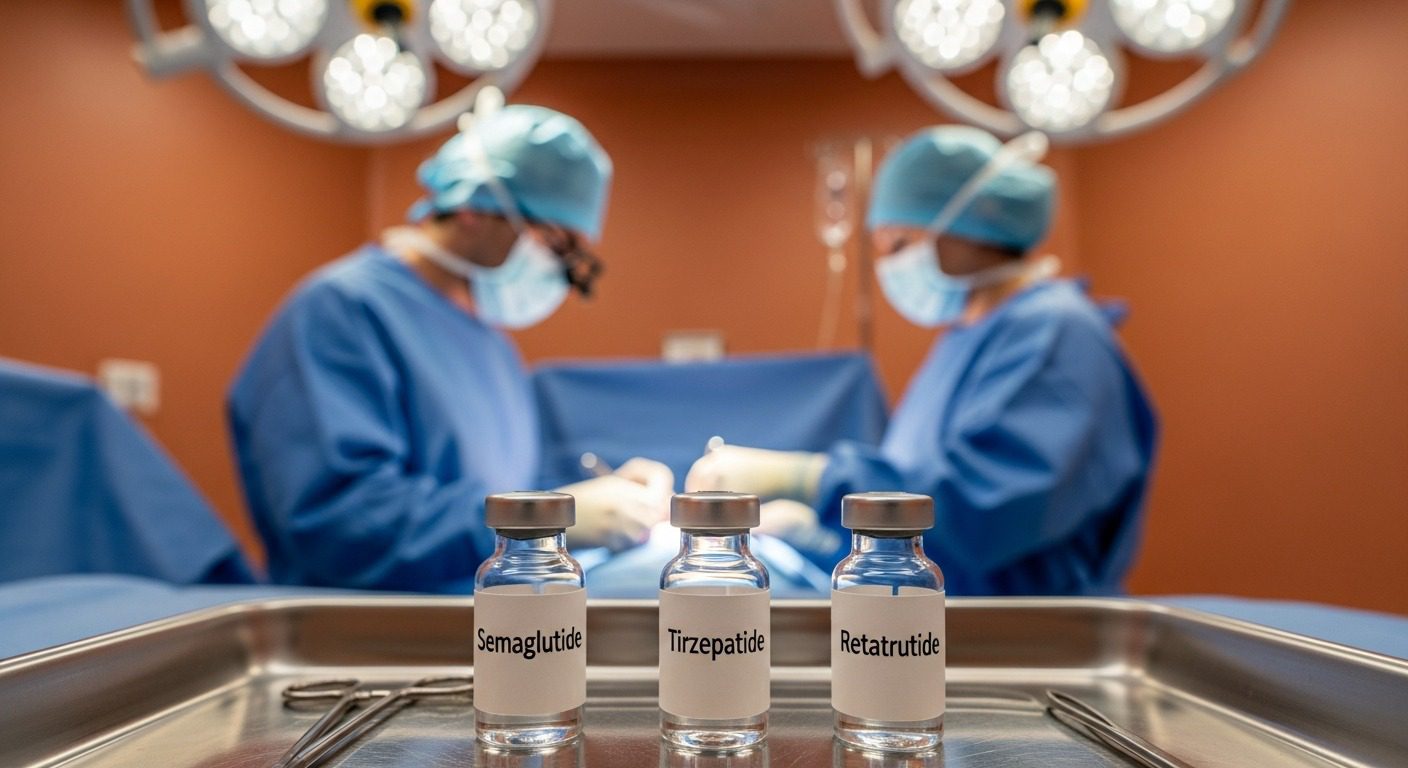
There are three compounded GLP-1-class medications in our program. They are not interchangeable, and I want patients to understand what they are choosing among.
Semaglutide is a single-receptor GLP-1 agonist. It is the original of the class. The published trial data shows roughly fifteen percent body weight loss at twelve months. For most candidates this is the first-line drug we prescribe.
Tirzepatide is a dual-receptor agonist. It mimics GLP-1 and a second hormone called GIP, the latter of which appears to spare a bit more lean mass while pushing weight loss further. Trial data is closer to twenty percent at twelve months. We move patients to tirzepatide when sema plateaus, when a larger total loss is needed, or when the patient’s clinical picture suggests it is the better starting drug.
Retatrutide is the newest of the three. A triple-receptor agonist hitting GLP-1, GIP, and glucagon. Early-phase data shows weight loss closer to twenty-five percent at a year. We offer it as a compounded formulation for select candidates only, with a higher level of supervision than the other two.
| Compound | Mechanism | Typical loss at 12 months | Where it fits in the program |
|---|---|---|---|
| Semaglutide | GLP-1 agonist | ~15% | Default first-line |
| Tirzepatide | GLP-1 / GIP agonist | ~20% | Plateau, larger loss goals, or as first-line in select cases |
| Retatrutide | GLP-1 / GIP / glucagon agonist | ~25% | Specific candidates, closely supervised |
The choice among these is a clinical decision, not a price-tier decision. We make it together at the intake visit.
BMI is not just a number on the chart
BMI matters in body contouring in a way that’s more concrete than most patients realize. Here’s roughly how I think about it.
Under thirty-two BMI is where I’d rather operate. Intra-abdominal fat is low enough that a real triple plication doesn’t fight the closure. The subcutaneous canvas is thin. Wound healing risk drops. Anesthetic risk drops. What the patient sees in the mirror at the six-month follow-up is what we both saw on the consult-room sketch.
Thirty-two to thirty-five BMI is still operable, but I’m setting expectations differently before we book. The plication doesn’t go all the way. The contour improves, but doesn’t transform. The recovery is the same length either way, which is why I’d rather we have the harder conversation up front.
Over thirty-five BMI is where I push hard for a weight loss program first, almost without exception. Operating in that range delivers what I’d honestly call a reality-check result. She leaves the OR with a tummy tuck that’s done what it can, but the result still reads “tummy tuck on a higher-BMI body.” Patients fly to El Paso for the other kind of result. So do I.
What’s shifted in the last eighteen months, more than anything else, is who qualifies. Patients I’d have had to send home in 2024 are operative candidates by month four of our program. That’s not a marketing claim. That’s a measurable change.
What three months of GLP-1 therapy does to a body contouring case
Let me be specific about what actually changes between consult day and surgery day for a patient who’s dropped thirty to forty pounds in our program.
I can feel her abdominal wall at the second consult. Three months earlier I couldn’t, because the fat was too thick. Now her diastasis is palpable through skin. I can map the umbilicus against the iliac crests. The choice between a full tummy tuck, a hybrid extended TT, and a Fleur-de-Lis abdominoplasty actually becomes a choice. Before the program it wasn’t.
A triple plication on her thirty-two-BMI abdomen is a different operation than a triple plication on her thirty-six-BMI abdomen would have been. More aggressive. More durable. The closure tension is different too. The wall I’m working with isn’t fighting me anymore.
And the BBL changes. Different proportions. Different harvest. Different graft canvas. Patients see the difference at the one-month follow-up, not the six-month one.
How the program is supervised
A word on supervision, because the GLP-1 space has been flooded with online services that don’t really deliver any.
I’m the medical director. My NP runs day-to-day. Every patient gets labs at intake. Every dosing change runs through her, and the cases that need me get me. Anyone with a complication calls our office, not a 1-800 number that picks up on Tuesday.
This matters because the side effect profile, while mostly favorable, includes pancreatitis, gallbladder disease, gastroparesis, and a few less common ones that need a real medical home. Patients on these drugs deserve a clinician who answers the 7 p.m. phone call. Ours do.
Who’s a candidate for the program, and who isn’t
The program fits a few patient profiles especially well. The body contouring candidate who’s stuck at a marginal BMI and has been told to come back lighter. The postpartum patient whose weight didn’t come off after eighteen months of trying everything that used to work. The forty- or fifty-something patient who’s watching the scale not move on a diet and exercise routine that worked just fine in her thirties. The patient who simply wants a structured medical path to dropping twenty to fifty pounds without taking on an internet protocol.
We don’t enroll everyone. Personal or family history of medullary thyroid carcinoma is an exclusion. So is MEN type 2. Active pancreatitis or significant pancreatic disease. Severe gastroparesis. Goals that don’t match what these drugs actually do. We catch those at intake, and we make those decisions honestly.
Why this lives inside our practice
We didn’t bring this program in-house for marketing reasons. We brought it in because the candidacy ground was shifting under our feet, and because the patients I most wanted to help were exactly the ones who’d been sent home year after year with no real path back to the OR.
I trained at Mayo Clinic. The fellowship taught me to think about volume, skin envelope, and structural support as one connected system, not three. The thirteen straight years on the Castle Connolly Top Doctor list, the academic appointment I’ve held at Texas Tech since 2011, the peer-reviewed work, all of it points the same direction. Stay close to what actually moves a patient’s outcome. Let the rest go. None of that intersected with weight loss medicine until the medicine began reshaping who walked into my body contouring consults. Once it did, outsourcing the program to a med spa across town wasn’t going to be my answer.
For a more editorial read on the cultural and aesthetic side of GLP-1 therapy, see my piece on drworldwide.com: The Vial in the Vanity: A Plastic Surgeon’s Honest Read on the GLP-1 Glow-Up.
Why choose Dr. Agullo for body contouring after GLP-1 therapy
Double board-certified by the American Board of Plastic Surgery and the American Board of Surgery. Fellow of the American College of Surgeons. Mayo Clinic plastic surgery fellowship. Clinical Associate Professor at Texas Tech University Health Sciences Center. Affiliate Professor at the University of Texas at El Paso. Castle Connolly Top Doctor for thirteen consecutive years. Texas Super Doctors Hall of Fame. Aesthetic Everything Top Plastic Surgeon, 2026. Approximately sixty percent of my body contouring patients fly into El Paso from out of town because the surgery, not the city, is what they are choosing.
Ready to talk?
If you have been told you are not a body contouring candidate at your current weight, that conversation is not over. It is the beginning of a different conversation. Come in. Let us look at your goals, your medical history, and the operation you want, then plan the path together. If a GLP-1 program is the right on-ramp for you, we will run it for you the right way. If you are already a strong surgical candidate, we will get you on the schedule.
Call (915) 590-7900, text 1-866-814-0038, or book online at agulloplasticsurgery.com/appointments. Follow along at @RealDrWorldWide on Instagram, TikTok, and Snapchat, @Agullo on X, or @AgulloPlasticSurgery on Facebook. #StayBeautiful