June 11, 2026 | Anti-Aging
At her yearly follow-up visit, the patient who sat across from me was someone I had been caring for over ten years. She had undergone surgery six years prior, which was the deep plane facelift. Her results had held up beautifully, as one would expect from well-performed surgery, though it wasn’t something we were discussing. Today, she was asking me what to do for the following decade: she was curious about NAD+ and had heard about GHK-Cu, a friend of hers was taking GLOW and she wanted to know what was real, what was hype and what I’d actually take. That was the genesis of this post. This is the longer, more clinical version, for anyone out there who wants the science on peptides alone (apart from surgery) as an anti-aging modality, presented in plain English.
What a Peptide Is
A peptide is a chain of amino acids connected via peptide bonds, usually composed of 50 or fewer amino acids. Our bodies churn out hundreds of thousands per day for signaling between different parts of the body, the body’s natural insulin, oxytocin and growth hormone, for example, are peptides. The peptides we use for regenerative medicine and longevity therapy are synthesized copies of endogenous molecules that have been manufactured according to current Good Manufacturing Practices (cGMP) as a finished drug, isolated, purified to a single species and accurately dosed. This last qualifier can’t be emphasized enough. A peptide arrives from your US 503A compounding pharmacy with a certificate of analysis stating its purity, potency, sterility and level of endotoxins. A peptide procured via a Telegram vendor in a nondescript vial is almost certainly neither. It might say the same molecule on the front of the bottle, but it’s rare to find it in the bottle.
Functionally, peptides are signal modulators. They dose the body to perform a function it already knows how to perform: lay down more collagen, repair DNA breaks, build more microvascular networks and restore mitochondrial energy. At a therapeutic dose, used cyclically, peptides enhance the existing processes your body would’ve performed anyway, peptides do not replace the biological function but tune it. This, therefore, answers the next question. No, peptides aren’t a substitute for surgery when the anatomy has been taken beyond what the cellular layer can salvage. They don’t replace the fundamentals of good sleep, adequate protein intake, resistance training, sun protection and avoiding lifestyle factors that prematurely age people. They’re an addition to the foundation.
NAD Plus and the Mitochondrial Side
Technically not a peptide but a coenzyme sharing menu items and a mechanistic neighborhood is NAD+. Nicotinamide adenine dinucleotide; the “nicotin” comes from the vitamin B3 family tree and is unrelated to nicotine, a fact I must start each consultation with. NAD+ is crucial for mitochondrial energy production, it serves as the cofactor for the Krebs cycle and oxidative phosphorylation, the cell’s ways of producing ATP. It’s also a substrate for SIRT1, a family of enzymes involved in DNA repair, DNA silencing and metabolic regulation. NAD+ levels diminish with age. This is one of the key drivers of mitochondrial failure, accumulation of irreparable DNA damage and cellular aging across tissues. There’s therefore a strong mechanistic case for providing older adults with extra NAD+. A good part of the human trial evidence is younger and less refined than what we see in animal models, although the trends are similar.
For NAD+ treatment, I use two options. The first is IV infusion. This is what most patients will have heard of. The major side effect can vary based on the drip rate: chest tightness, flushing, nausea and a sensation of burning in the veins if the drip rate increases too quickly. With infusion rates from 250mg to 500mg over two to three hours, this is usually well-tolerated. We always infuse slowly. While the “wow, I feel great afterward” reports on the internet are real and describe the post-infusion energy and clarity boost, there’s a slower, far less remarkable process of cellular repair ongoing for days after the infusion.
The second is subcutaneous NAD+. Lower-dose subcutaneous injections fill in the gap between infusions. Given the poor bioavailability of oral NAD+ and its precursor vitamins through supplements (and why most wellness supplements have limited benefit), IV or subcutaneous routes are necessary to achieve the serum concentrations observed in the published research. For the purpose of anti-aging therapy (with no surgical adjunct), I typically place patients on one IV infusion monthly, maybe a few times the first month, and then encourage subcutaneous doses weekly or every two weeks in between. Many patients elect to combine NAD+ with glutathione (another tripeptide, an antioxidant that supports phase 2 liver detox) and are often placed on a monthly infusion of each. We’ll administer the NAD+ first via IV and then the glutathione immediately thereafter.
GHK-Cu, the Skin Investment That Runs Deeper Than Topical
GHK-Cu is glycyl-L-histidyl-L-lysine copper. This tripeptide occurs naturally in the plasma of humans. Levels peak in one’s twenties, then gradually decline throughout life. This peptide is the active ingredient in the topical copper peptides that have been sold as cosmetic agents on the dermatology shelf since the late 1980s, with the caveat being that topical GHK-Cu needs to penetrate the stratum corneum layer of skin before getting to the dermis, which houses the receptors for the peptide. Healthy skin is an excellent barrier for macromolecules like this one. However, when given subcutaneously, GHK-Cu bypasses this barrier and the peptide gets into circulation systemically at the desired dose. The mechanism involves stimulating over 300 different genes associated with tissue repair and remodeling, fibroblast activation and collagen synthesis, epidermal basal stem cell viability, an anti-inflammatory effect, an antioxidant effect and stimulation of microvascular growth. Clinically this translates to an improvement in dermal density, skin elasticity and skin tone that’s superior to what can be achieved topically. Preclinical evidence and early clinical evidence exist also for hair regrowth and follicle health.
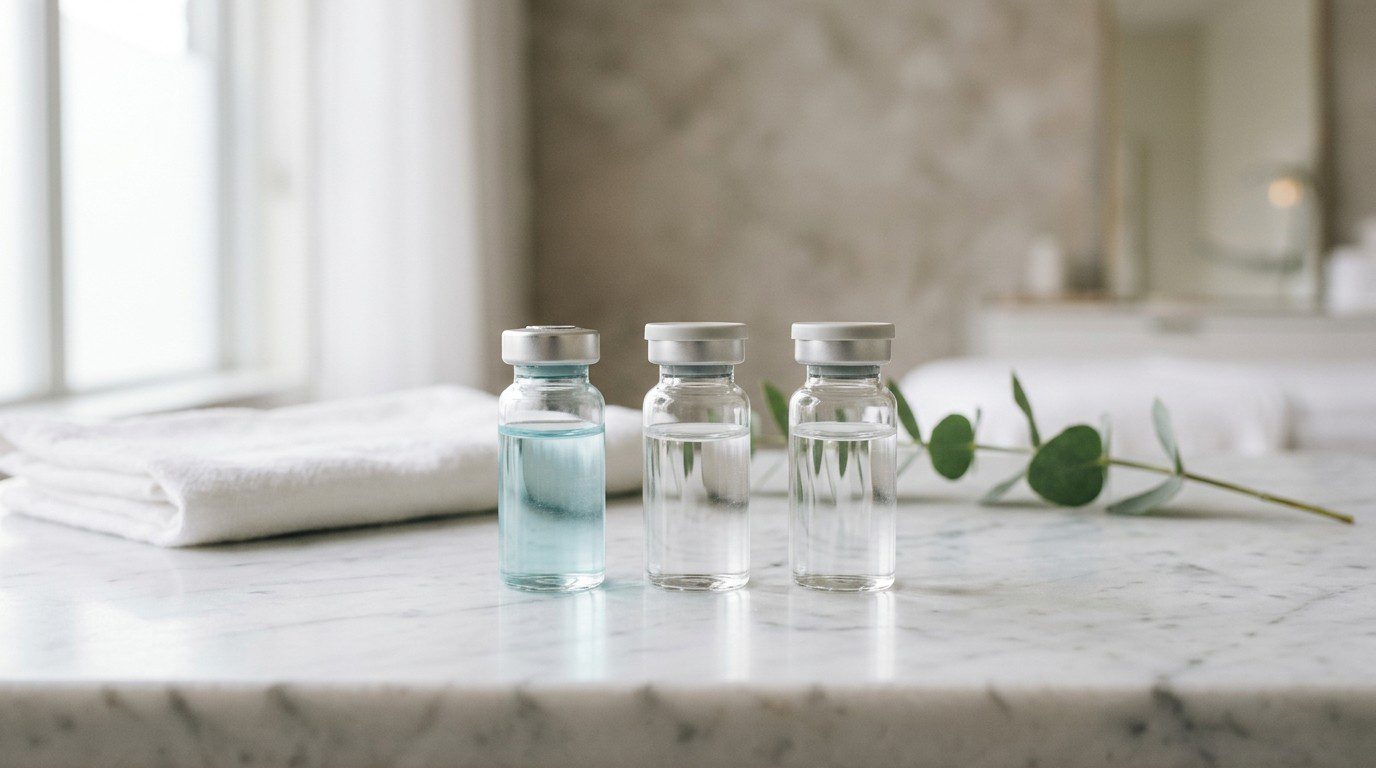
My usual GHK-Cu candidate is a woman in her early to mid-forties, doing the correct external things but who knows surgery isn’t yet the correct option for her face. She simply wants the underlying cellular component of her plan to do something substantial. This usually involves a dose of one to two milligrams given subcutaneously daily for ten to 21 days, repeated as needed based on her results. The blue color is from the copper. It’s normal.
GLOW, and Why I Use It Differently Outside Surgery
GLOW is my pharmacy’s blend of GHK-Cu, BPC-157 and TB-500. While these three peptides each have a valuable role in surgical recovery, where collagen, angiogenesis and cell migration are what any healing surgical site needs, the same can’t be said for ongoing wellness use. The problem with daily long-term therapy is that while BPC-157 and TB-500 have an abundance of science behind their roles in tissue repair, which is exactly what they’re intended for, for ongoing wellness without a diagnosis of injury they are likely far beyond the dose-response curve at which beneficial effects can be proven. Thus, I favor using the whole blend when it’s indicated for recovery. Thus, the exception: the patient with chronic soft-tissue damage, inflammation or who’s in the midst of post-injury repair. In that scenario, a defined cyclical course of the full GLOW blend has considerable validity, supported by studies looking at the synergy of the two latter peptides.
Who Is a Candidate, and Who Is Not
I’m generally seeing a wellness candidate somewhere between 30 and 65 who’s generally healthy, free of active malignancy, free of infection and willing to go through the multi-month journey with appropriate follow-up appointments. The consultation will include all pertinent medical history, all of their current medications and usually lab work in advance of the consult to improve the assessment; additionally, there will be an in-depth discussion of your goals and timelines.
First, we absolutely do not recommend growth-factor-like peptides in patients with active malignancy, as we can’t promote the growth of potentially undiscovered tumors. For patients with a personal history of any cancer, even if treated, resolved and with all signs removed, this is generally an area of discussion that is longer and frequently requires an oncology clearance beforehand; though the literature doesn’t indicate a causal link with cancer recurrence from these specific peptides, we are cautious. Pregnancy and breastfeeding are off limits. Patients who are on anticoagulants (i.e., blood thinners) will have their dose adjusted under the care of their cardiologist or hematologist; sometimes the peptide dosing is as straightforward as a reduced dose per administration, but we must involve specialists. Asthmatic patients who have opted for NAD+ alongside glutathione must be watched carefully since IV glutathione can rarely trigger bronchospasm.
What Peptides Do Not Replace
SPF isn’t replaced by peptides. Adequate sleep for seven to eight hours per day isn’t replaced. Adequate protein, resistance training, blood pressure management or any other piece of the preventive medicine paradigm are not replaced by peptides either. Used properly as an adjunct to everything, peptides are a great addition. If you’re instead replacing them, it’s likely an expensive try. No, peptides do not replace surgery when that’s what the patient’s face demands. If a person has lost the underlying support of their cheeks, their jawline and their neck, peptides aren’t going to restore it. A deep plane facelift, when performed correctly and then supplemented by a peptide protocol post-op for recovery and then longevity support, is the correct answer. I’ve seen too many patients who spend the cost of a facelift on years of peptides and delay the inevitable, only to later come to my office not looking any younger and having burned through their savings for the eventual needed surgery. While it might be easier to present a more hopeful outlook, the honest version provides better results.
The Cautious Side, and Why Source Matters
The peptides I have discussed are not new drugs and the pathway to drug approval hasn’t been used. They’re compounded at a prescription under a physician’s authorization by US 503A compounding pharmacies. This is perfectly legal. It’s also why the black market has so many poorly labeled vials, of unknown dose and unknown purity. My chosen compounding pharmacy is a US-based facility, is cGMP-certified and provides a certificate of analysis with every single batch. Yes, the price is higher than a vendor operating on Telegram. That cost difference is the entire point, and it’s what you’re paying for. Also, you can’t just take a compounded peptide blend and add to it freely. Adding in four new, random peptides in addition to the compounded blend (from what you read on the internet, a podcast or other form of non-medical avenue) is not optimizing the process, it’s creating the potential for an unwanted hormonal or hematologic cascade. If a patient wants to change their protocol, we sit down at the consultation and discuss their goals, new prescriptions will be written for the other molecules and those will be delivered from my compounding pharmacy.
For the editorial, shorter version of this post, see The Quiet Way I Treat Aging: NAD Plus, GHK-Cu, and the Peptides I Stand Behind on drworldwide.com. For the practice wellness program, see NAD Plus, GHK-Cu, and the Peptide Wellness Program at Southwest Plastic Surgery.
Why Choose Dr. Agullo
I’m board-certified in plastic surgery by the American Board of Plastic Surgery and board-certified in general surgery by the American Board of Surgery. I’m a Fellow of the American College of Surgeons. I trained in plastic surgery at the Mayo Clinic in Rochester, Minnesota. I serve as a Clinical Associate Professor in the Department of Plastic Surgery at Texas Tech University Health Sciences Center and teach the plastic surgeons who are currently being trained in techniques that I perform on a weekly basis. I’m also an Affiliate Professor at UTEP. In addition, I’ve consistently been selected as a Castle Connolly Top Doctor for the last thirteen years. All peptides I prescribe are sourced through US cGMP-certified compounding pharmacies. The peptides are dispensed per patient, dosed and adjusted at follow-ups. At Southwest Plastic Surgery, wellness peptide consultations proceed precisely like surgical consultations: we go through a complete medical history, we develop an appropriate plan and we institute a real cadence to ensure the most appropriate protocol is followed for you.
Ready to Talk?
If you’re interested in determining whether a peptide protocol is a good fit for you, the most practical first step is to schedule a wellness consultation. During the appointment, we’ll thoroughly review your medical history, current routine and your specific aesthetic objectives for your face and body over the next ten years. If peptides appear to align with your goals, we’ll develop a personalized protocol. If they don’t, you’ll be the first to know. Contact me today by calling (915) 590-7900, texting 1-866-814-0038 or by booking online at agulloplasticsurgery.com. Follow my social channels at @RealDrWorldWide on Instagram, TikTok and Snapchat, @Agullo on X or @AgulloPlasticSurgery on Facebook. #StayBeautiful.