May 01, 2026 | Recovery
A patient I had operated on three weeks earlier sat down across the desk, looked in the hand mirror she had brought, and asked the question I get more than any other at the two week visit. Why she felt this good, this soon. The bruising she had been warned about did not really show up. The fatigue lasted four days, not two weeks. She slept the night of surgery and every night after.
The honest answer has three parts. The first is the operation. A well-executed deep plane facelift releases the four retaining ligaments and repositions tissue without tension, which produces less swelling and bruising than the older skin-tightening technique. The second is anesthesia and a meticulous closure. The third is the back end, a supervised peptide protocol I have refined over the last several years and now offer almost every surgical patient.
This is the longer, detailed, scientific write-up for the patient consultation room. You may read the shorter, opinionated editorial piece on my blog at drworldwide.com if you’re more inclined to the lay public interpretation. This entry will be more tailored to the patient wanting the precise clinical information, dosages, qualification criteria and important disclaimers, delivered without jargon.
What a peptide actually is, in clinical language
A peptide is a short chain of amino acids, generally fewer than fifty, joined by peptide bonds. The body manufactures thousands of them every day to send signals between tissues. Insulin is a peptide. Oxytocin is a peptide. Growth hormone is a peptide. The therapeutic peptides used in surgical recovery are synthetic versions of molecules the body already makes, manufactured under cGMP pharmaceutical conditions, purified to a single active species, and dosed precisely.
That last clause is the one that distinguishes a prescription peptide from a supplement. A peptide arriving from a US 503A compounding pharmacy comes with a certificate of analysis identifying purity, potency, sterility, and endotoxin levels. A peptide arriving in an unlabeled vial from a Telegram vendor does not. The molecule may be the same on the label. It is rarely the same in the bottle.
When used, signal modulation occurs at varying frequencies to achieve the required effects. This dosage essentially instructs the body to do something it inherently already does. Peptides assist the body in healing, building, producing new blood vessels or energizing cellular respiration processes over an accelerated healing period. Peptides don’t usurp or change basic processes-they enhance them when used properly within their therapeutic doses over specific periods.
GLOW for face, KLOW for body
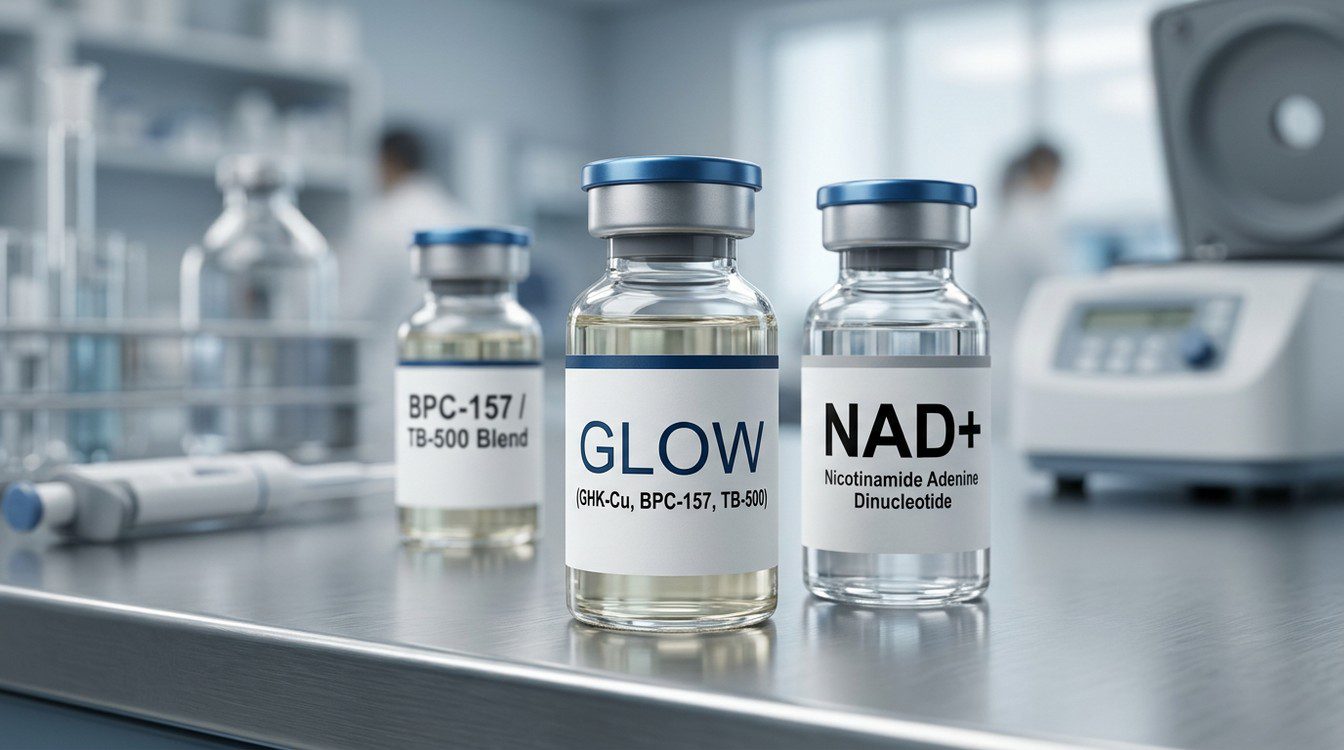
I prescribe two related peptide blends, depending on the operation. GLOW is a three-peptide blend (GHK-Cu, BPC-157, TB-500). KLOW is the same three peptides plus a fourth, KPV. The reason the menu has two versions is that face and body procedures call for different emphasis on the recovery side, and the right blend tracks the operation.
GHK-Cu-Gly – His-Lys – is a copper-binding tripeptide that’s present naturally in human plasma. As men and women age, GHK-Cu levels fall in significant and quantifiable ways. GHK-Cu is the ingredient contained within the topical copper peptides that have been available in beauty clinics for forty years, the main caveat being that topical GHK-Cu must successfully penetrate the stratum corneum to access the dermis. In contrast, GHK-Cu administered subcutaneously is released into the bloodstream instantly and in a controlled dose, which triggers more than 300 repair-related genes, helps to multiply fibroblast growth and contributes to the longevity of epidermal stem cells located in the basal layer. A facelift patient will notice that incision line scars heal much flatter and lighter and that the skin within the surgical site improves dramatically during the course of the six-month repair process.
BPC-157 (Body Protection Compound 157) is a fifteen amino acid synthetic peptide derived from a protein in human gastric juice. The published research base, predominantly preclinical with growing clinical extension, identifies several mechanisms of action. The most relevant to surgical recovery is angiogenesis, the formation of new capillary networks at injury sites. New tissue cannot survive without blood supply. The body builds that supply slowly. BPC-157 accelerates the process. The molecule also modulates nitric oxide signaling, dampens local inflammation, supports tendon and ligament repair, and protects gastric mucosa from NSAID injury, which is incidentally why I sometimes pair it with the analgesia plan.
TB-500 is a synthetic analog of Thymosin Beta 4, a naturally occurring peptide found in nearly every cell, with the highest concentrations in blood platelets and wound healing fluid. Its mechanism is actin regulation. Actin is the cellular protein that forms the cytoskeletal rails along which repair cells migrate. By modulating actin sequestration, TB-500 accelerates the rate at which those repair cells reach the site of injury. Clinically, BPC-157 and TB-500 are synergistic. BPC-157 builds the new microvasculature, TB-500 mobilizes the cells that use it.
KPV is a tripeptide (lysine-proline-valine) derived from alpha-MSH. Its mechanism is anti-inflammatory. KPV inhibits NF-kB, a transcription factor that serves as the central regulator of multiple inflammatory gene programs. Where BPC-157 and TB-500 reduce localized inflammation as a side effect of their primary regenerative actions, KPV acts as the designated anti-inflammatory driver. For face procedures, where the inflammatory field is small and the priority is incision quality and skin remodeling, GHK-Cu does most of the work, so I run GLOW. For body procedures (BBL, gluteal fat grafting, tummy tuck, mommy makeover, and breast surgery), in which the inflammatory load is considerable, I add KPV to the same three peptides. That is KLOW. The blend is still a once-daily injection from the same compounding pharmacy, with broader anti-inflammatory coverage where the surgical field calls for it.
Comparison: the four peptides, side by side
| Peptide | Primary mechanism | Best surgical fit | In which blend |
| GHK-Cu | Collagen and elastin synthesis, activation of 300+ tissue repair genes | Facelift, neck lift, eyelid surgery, skin-heavy procedures | GLOW and KLOW |
| BPC-157 | Angiogenesis, anti-inflammatory, GI mucosal protection | Body procedures, BBL, tummy tuck, anywhere new vasculature is needed | GLOW and KLOW |
| TB-500 | Actin regulation, accelerated repair cell migration | Soft tissue procedures, BBL, breast surgery, range-of-motion concerns | GLOW and KLOW |
| KPV | NF-kB inhibition, dedicated anti-inflammatory | Body procedures with significant inflammatory load (BBL, tummy tuck, breast, combination) | KLOW only |
I dose both blends subcutaneously, abdomen or thigh, once daily for the first three to four weeks postoperatively. Most patients self-inject at home with a 30 gauge insulin syringe. We adjust at each post-op visit. The expected dose for the standard 50/10/10 milligram GLOW blend lands in the range of 250 to 600 micrograms of BPC-157 daily, with proportional GHK-Cu and TB-500. KLOW is dosed similarly, with KPV added at the manufacturer-specified concentration. Exact dose is patient-specific.
NAD plus, and the mitochondrial side of recovery
NAD+ is a different molecule for a different problem. It is Nicotinamide Adenine Dinucleotide, technically a coenzyme rather than a peptide, but prescribed off the same regenerative menu and synergistic with the peptides above. The “nicotin” in the name is vitamin B3 etymology and bears no relationship to nicotine, a clarification I make at the start of every consult.
NAD+ is essential to mitochondrial energy production. It fuels the citric acid cycle. It activates the sirtuin family of enzymes, which regulate DNA repair and cellular maintenance. NAD+ levels decline measurably with age, with stress, and with illness. Surgery imposes all three. Recovery is a period of accelerated cellular work, and that work is bottlenecked when NAD+ availability is low.
The default protocol I prescribe is at-home, subcutaneous or intramuscular. Patients go home with a one-month supply, 250-500 mg total, divided into two doses per week for four weeks. Eight injections over the recovery window, sixty-something milligrams each. It is well tolerated, easy for patients to self-administer, and it keeps mitochondrial support steady through the period when the body is doing the most cellular work. Oral bioavailability of NAD+ and its precursors is poor, which is why supplements at the wellness shop are mostly a waste of money. Subcutaneous or intramuscular delivery is the only at-home route that produces the systemic NAD+ levels associated with published outcomes.
For patients who want the IV layer on top of the at-home protocol, we offer a NAD+ plus glutathione infusion. One before surgery, one after. The pre-op infusion (typically a few days before the operation) primes mitochondrial reserves before the surgical stress. The post-op infusion (within the first week) replenishes during the highest-demand recovery period. Glutathione is added as a slow IV push at the end of the NAD+ drip. It is an antioxidant tripeptide that supports phase 2 liver clearance and helps clear the residual metabolites of anesthesia.
The IV experience deserves an honest description. Run too fast, NAD+ causes chest tightness, flushing, nausea, and a hot burning sensation. That is rate-dependent and expected. Run slowly, the typical infusion is 500 mg of NAD+ over two to three hours followed by 1000 to 1500 mg of glutathione pushed over five to fifteen minutes. The patient is comfortable for the entire session. We always run NAD+ slowly. Asthma patients are watched for bronchospasm during the glutathione push because injectable glutathione can rarely trigger it.
How I match the protocol to the procedure
The protocol is not a single template. The dosing and the duration shift with the operation.
Facelift, neck lift, blepharoplasty: GLOW once daily for three to four weeks. Subcutaneous NAD+ at 500 mg per month divided into eight twice-weekly doses across the recovery window. Optional NAD+ plus glutathione IV infusion before surgery and within the first week after.
BBL, gluteal fat grafting, body contouring, tummy tuck, mommy makeover: KLOW once daily for four to six weeks. KPV adds the dedicated anti-inflammatory layer that a large surgical field benefits from. Subcutaneous NAD+ at the same monthly schedule as facelift patients, sometimes extended through the second month when transferred fat is establishing its new blood supply. Optional IV pre-op and post-op.
Breast surgery, including preservation augmentation with Motiva Preserve: KLOW once daily for three to four weeks. Particular attention to BPC-157 dosing if the patient is using NSAIDs for analgesia. Subcutaneous NAD+ on the standard monthly schedule. Optional IV pre-op and post-op.
Combination procedures (face plus body, or any multi-site case): KLOW by default, since the inflammatory load wins. Longer cycle, individualized at consultation. Standard NAD+ schedule, often with the optional IV included.
Isolated minor procedures (lip lift alone, blepharoplasty alone): may not need a peptide cycle at all. I will tell a patient that.
Who is a candidate, and who is not
Inquire about preferred smoothness of recovery, four- to six-week daily self-injection capability and documented health history for tolerance. In most cases, it’s acceptable. Avoid in active malignancies, the protocol shouldn’t exacerbate undiagnosed tumors. Not suitable for pregnant/nursing women. Defer protocol in cases of acute infections until resolved. Carefully adjust dose for patients on anticoagulant therapy under cardiological/hematological management. Monitor NAD+ infusion patients with asthma history, as glutathione, sometimes combined with NAD+, rarely induces bronchospasms.
Patients with a personal history of any cancer, even if treated and clear, get a longer conversation and often a clearance from oncology before we proceed. The literature does not show a causal link between these specific peptides and recurrence, but the prudence is warranted.
The cautious side, and why source matters
Peptides aren’t approved in the same way. A doctor will prescribe them to a 503A compounding pharmacy in the US to fill, which is legal. Why? Because we see people getting their 503B vials from a vendor on Instagram or Telegram in an unlabeled bag with no quality control, dose amount or sterility issues. The drug is injected sterile IM/SQ. The drug coming from the 503B grey vendor is a disaster waiting to happen, clinical Liability Nightmare for some wellness influencer to write a blog about.
The pharmacy I use is US-based, cGMP-certified, and issues a certificate of analysis with every batch. Cost is higher than the gray market. That difference is what you are paying for.
The second rule, equally important, is that compounded peptide blends are calibrated. Adding random fourth and fifth peptides on top of a prescribed blend, because of a podcast or a forum post, is not optimization. It is a way to give yourself an unintended endocrine or hematologic problem. If a patient wants to expand the protocol, that conversation happens in my office, with new prescriptions written for the new molecules.
Why choose Dr. Agullo for a peptide-supported recovery?
Double board-certified, American Board of Plastic Surgery and American Board of Surgery. Fellow of the American College of Surgeons. Mayo Clinic plastic surgery fellowship. Clinical Associate Professor of Plastic Surgery at Texas Tech University Health Sciences Center, teaching the same techniques I use every week. Affiliate Professor at UTEP. Castle Connolly Top Doctor for thirteen consecutive years. The peptide protocol described above is prescribed by me, sourced through a US cGMP-certified compounding pharmacy, dosed for the patient and the procedure, and integrated into a recovery plan I have built operating on local, national, and international patients for the last fifteen years.
For a more editorial, shorter read on the same protocol, see my piece on drworldwide.com: After the Operating Room: The Peptide Stack My Patients Recover On.
Ready to talk?
The right time to begin the recovery conversation is during the initial surgical consultation, not the day before surgery. We will review your anatomy, the operation you are considering, your medical history, and we will decide together whether peptides belong in your plan. If they do not fit, I will say so. If they do, you will leave the consultation with a written protocol, a price, and a timeline. Call (915) 590-7900, text 1-866-814-0038, or book online at agulloplasticsurgery.com. Follow along on social at @RealDrWorldWide on Instagram, TikTok, and Snapchat, @Agullo on X, or @AgulloPlasticSurgery on Facebook. #StayBeautiful.