
April 24, 2026 | Facelift
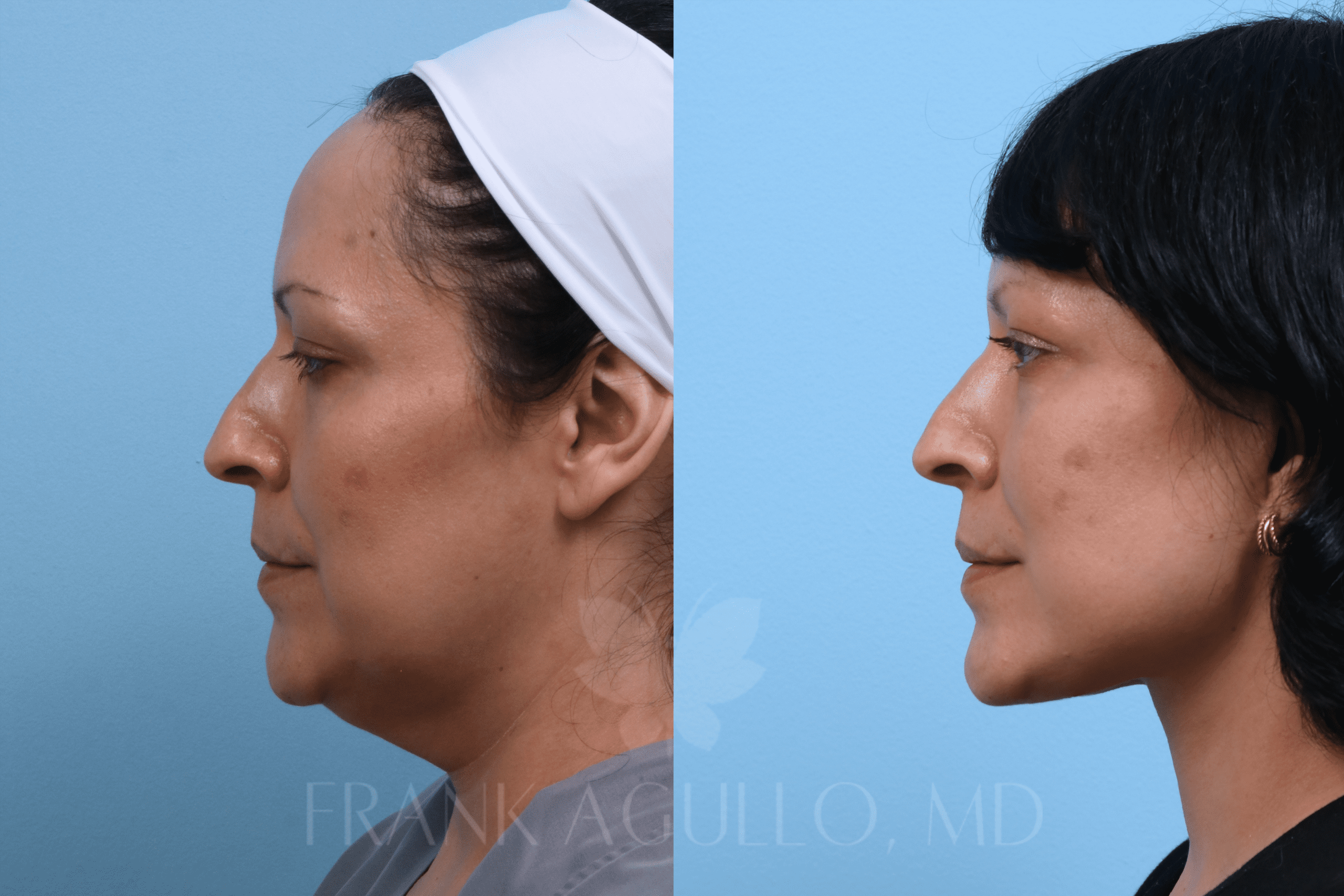
A patient sat down across from me last month, pulled her hair back into a high ponytail, stared into the mirror, and tapped her jawline. “Everything else about getting older I can handle,” she told me. “Not this.”
What she didn’t realize is that she had just told me which facelift she was a candidate for.
My facelift consultations used to be about whether to have one. In 2026 they aren’t. They are about which one, and about where the incisions go. And for the right anatomy, the whole operation now happens inside the hairline.
What a Deep Plane Facelift actually does
For a long time the standard facelift was simple on paper. You lifted the skin, tightened a thin fascial layer underneath called the SMAS, and closed up. Patients left happy. Five years later most of them still looked good. Ten years later, a lot of them didn’t. Skin has memory. Tension leaks out of it. And when a patient with a stretched-out first facelift comes back for a second one, the second one almost always looks more “done” than the first.
The Deep Plane Facelift throws out the pull-on-skin premise. It dissects beneath the SMAS, releases the retaining ligaments that anchor the face to the skull (zygomatic, masseteric, mandibular, and platysma), and moves the entire composite flap as a single block. Skin, SMAS, fat, muscle. All at once. Nothing is stretched. Nothing is tight. Nothing is set up to fail in year seven.
The longevity numbers follow from that. The peer-reviewed literature on deep plane results now runs ten, twelve, even fifteen years.
The quick comparison:
| Aspect | Traditional SMAS facelift | Deep Plane Facelift |
| What moves | Skin and a thin SMAS layer | Skin, SMAS, fat, and muscle together |
| Ligaments released | No | Yes (all four) |
| Skin tension | High | Low |
| Typical longevity | 6 to 8 years | 10 to 15 years |
| The “pulled” look | Possible over time | Rare; tissue is not stretched |
Where the Ponytail Lift comes in
The Ponytail Lift is the same Deep Plane Facelift with a different front door. Same plane. Same ligament releases. Same composite flap. But the incisions live somewhere else entirely.
The traditional deep plane incision runs in front of the ear, wraps around the earlobe, and tucks up into the hairline behind. Closed well, it heals to something most people will never notice. But most people is not the same as no one, and a certain patient cannot live with the possibility of somebody noticing.
The Ponytail Lift solves that. All the work is done through small openings tucked inside the hairline, with an endoscope providing the view instead of a scalpel-and-retractor exposure. No incision in front of the ear. No tension at the earlobe. No scar a patient has to style around.
It is not an easier operation. It is harder. The access is tighter, the view is indirect, and there is less room to correct a mistake. That is why a lot of surgeons list it on their websites and comparatively few have actually trained to do it.
Who is (and isn’t) a Ponytail Lift candidate
The right candidate is usually in her forties or early fifties. Early to moderate midface descent. Jowl forming but not dominant. Skin with elasticity still in it. And a hard line against any visible pre-auricular scar. Thick hair is a bonus, because it buries the hairline incisions completely.
The wrong candidate is a patient in her mid-sixties and beyond, or one whose skin has already given up on elasticity. That anatomy needs the traditional open Deep Plane, because you actually have to excise skin, not just reposition the tissues underneath it. A Ponytail Lift will under-deliver on that face.
Telling you which of those two you are is part of my job in a consultation. I am not a Ponytail Lift surgeon or a traditional deep plane surgeon. I am both, and I will recommend the one that suits your face. If that is the open operation, we go open. If it is the endoscopic one, we go through the hairline.
Why I went to the Ponytail Academy twice
I could have read the papers, watched a cadaver course on YouTube, and told my patients I offer the Ponytail Lift. That is what some surgeons do. I was not interested in being one of them.
I took the Ponytail Academy Intermediate Course in Pittsburgh first. Days in the lab, cadaver dissection, real-time correction from the faculty who developed the technique. Then I went back for the Advanced Course in Santa Monica. Same format, deeper.
Plastic surgery is a craft. You learn it from people who have done it ten thousand times, in a room where they can correct you before you take that correction back to a patient. That is how Mayo Clinic taught me during my fellowship. That is how I wanted to learn this.
One more thing about fillers
Fillers are a tax. You pay it every six to twelve months, and when you stop paying, the face resets.
A Deep Plane Facelift is different. You pay once, and it appreciates for the decade that follows. Patients who have been chasing volume loss with filler for years often show up to my office with a face that looks fuller, not younger. Puffy cheeks, no jawline, odd upper-lip volume. That is the filler tax, paid too many times.
If filler is right for you, I will use it. If surgery is right for you, I will do it right. The goal is the same. The face you recognize in the mirror. #StayBeautiful.
Why choose Dr. Agullo for a facelift in El Paso
Double board-certified (American Board of Plastic Surgery, American Board of Surgery). Fellow of the American College of Surgeons. Mayo Clinic plastic surgery fellowship. Clinical Associate Professor of Plastic Surgery at Texas Tech University Health Sciences Center, where I teach the same techniques I use every day. Affiliate Professor at UTEP. Castle Connolly Top Doctor for thirteen consecutive years. Ponytail Academy, intermediate in Pittsburgh, advanced in Santa Monica. Over 3.5 million followers across Instagram, TikTok, and Snapchat, because my patients want to see the work before they trust me with their face.
Ready to talk?
Every facelift consultation in my office starts the same way. I evaluate your anatomy, listen to what you actually want, and tell you honestly what a Deep Plane Facelift or a Ponytail Lift would do for you. If the answer is “not yet,” I will say so. If it is yes, I will walk you through exactly what happens in the OR and through recovery.
For a deeper read on the philosophy behind these two operations, see my piece on drworldwide.com: The Facelift You Can’t See: Deep Plane and the Ponytail Lift.
Call (915) 590-7900, text 1-866-814-0038, or book online at agulloplasticsurgery.com/appointments. Follow along at @RealDrWorldWide on Instagram, TikTok, and Snapchat, @Agullo on X, or @AgulloPlasticSurgery on Facebook.