
April 28, 2026 | Skin Care Regimen
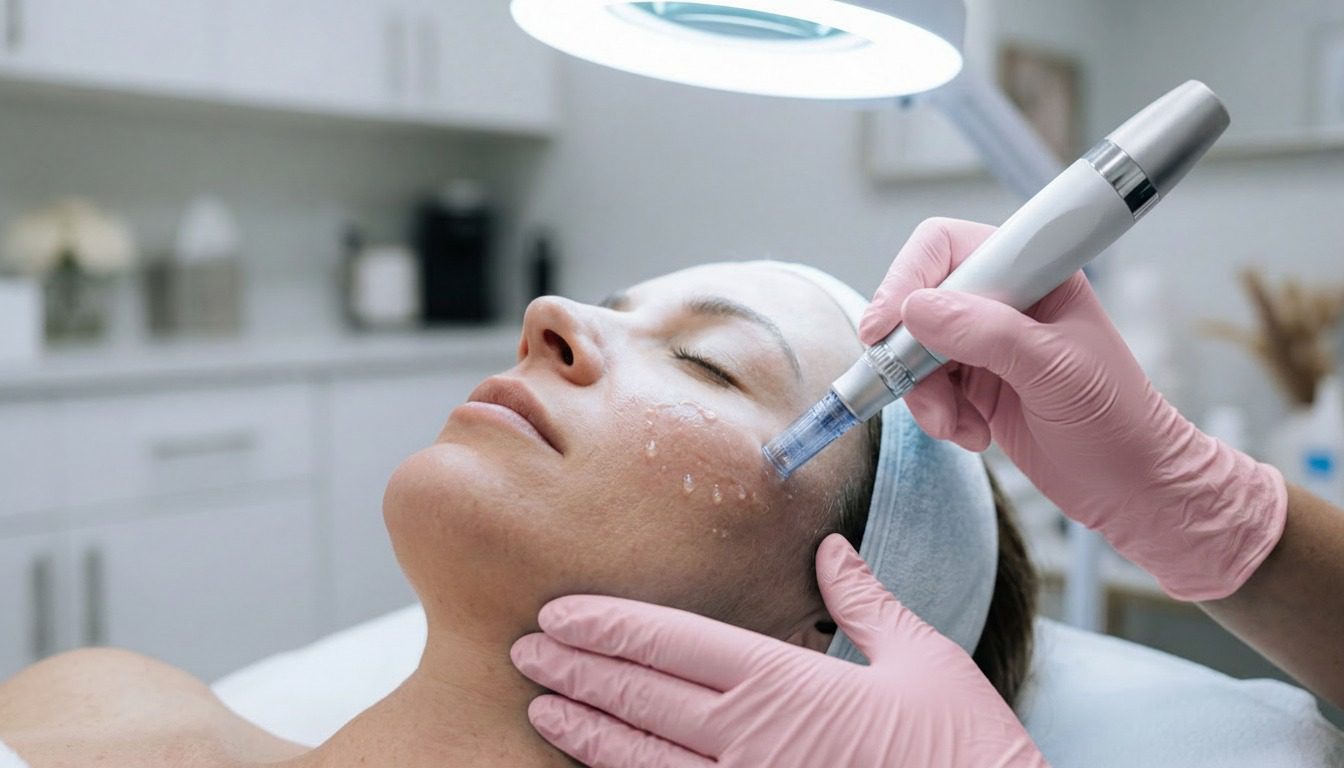
A patient I have known for years sat down for her annual Morpheus8 session last month, looked at the tray, and asked me a perfectly reasonable question. Where is the blood draw. We had done platelet-rich plasma after every one of her treatments for the past five years. The tube, the centrifuge, the patient bandage on the inside of her elbow at the end of the visit. It had become the rhythm of the appointment.
I told her we were trying something different. A small kit, a one-minute mix, no needle in the arm. Same idea as PRP. Cleaner version of it. And I walked her through the science the same way I am about to walk you through it.
This is the longer, more clinical version of a conversation I have been having in my consultation room every week. The shorter, editorial read is on my personal blog at drworldwide.com. This piece is for the patient who wants the data, the pharmacology, and the disclaimers in plain English.
What pure PDGF actually is
Platelet-derived growth factor is one of the body’s lead first-responder proteins at any tissue injury. When platelets release at a wound site, PDGF is the protein that recruits fibroblasts to lay down collagen, calls in mesenchymal cells, and helps build the new microvasculature that healing tissue needs. PDGF is the most studied tissue growth factor in regenerative medicine, with over a hundred clinical trials and four FDA-approved drug products in non-cosmetic medical indications (GEM 21S, Augment, Augment Injectable, and Regranex). Over the past twenty-eight years, more than five and a half million patients have been treated with PDGF-containing FDA-approved products in those non-cosmetic indications. The molecule has a long safety record.
For most of the past decade, the way clinicians delivered PDGF to skin in an aesthetic context was indirect. We drew patient blood, spun it down, and applied platelet-rich plasma to freshly microneedled skin. PDGF was in there, alongside dozens of other proteins, in concentrations that varied with each patient and each centrifuge run. The mechanism was right. The dosing was loose.
Recombinant pure PDGF is the next step. The protein is produced in cultured cells from a human gene sequence, then purified to a single active species. The label calls it sh-Polypeptide-59 Dimer. There are no human-derived components in the formulation, which is one of the reasons regulators view recombinant proteins more cleanly than donor-derived material. The dose is controlled by the manufacturer, not by what the centrifuge happened to spin down that morning.
Ariessence pure PDGF+ is the brand. The kit pairs five syringes of pure recombinant PDGF-BB with one vial of hyaluronic acid serum. Mixing takes under a minute in the treatment room. The product is sold to clinicians and is intended for application immediately after microneedling, RF microneedling, fractional laser resurfacing, or chemical peels.
Why topical, and why specifically post-procedure
Topical PDGF on intact skin is, charitably, a moisturizer with an interesting label. The protein is too large to cross an intact stratum corneum in a meaningful concentration. The barrier function of healthy skin is highly effective at keeping macromolecules out. That is the barrier doing its job.
The post-procedure window is different. After Morpheus8, traditional RF microneedling, fractional non-ablative or ablative laser, or a medium-depth peel, the skin has thousands of microchannels open to the dermal compartment for a finite period (often quoted at two to six hours, depending on density and depth of injury). During that window, topically applied molecules in an appropriate vehicle can reach the dermal compartment that is actively recruiting growth factors anyway.
This is the entire scientific rationale for applying PDGF topically immediately after microneedling. The procedure does the delivery. The product provides the signal. Outside that window, neither claim holds.
The Gold 2025 randomized controlled trial
In September 2025, Gold and colleagues published a prospective, evaluator-blinded, randomized controlled trial in the Journal of Cosmetic Dermatology. The full citation:
Lynch SE, Huxel ST, Bond R, Biron J, Gold M. Recombinant pure PDGF improves skin rejuvenation following RF microneedling: A prospective, randomized, controlled clinical trial. Journal of Cosmetic Dermatology, published online 12 September 2025. DOI: 10.1111/jocd.70425.
Trial design in summary. Subjects were thirty to sixty years old, healthy, no exclusion conditions, all received a single Morpheus8 RF microneedling session under standardized parameters. They were randomized to receive either bland Aquaphor or up to one cubic centimeter of recombinant human PDGF-BB at three hundred micrograms per milliliter in a sterile physiologic solution applied topically immediately after the procedure. Subjects were evaluated at seven and thirty days using the Clinical Global Aesthetic Improvement Score (CGAIS) by a blinded evaluator, plus Canfield Visia objective image analysis, plus patient-reported outcome measures.
Results. The PDGF group showed a statistically significant improvement in CGAIS at thirty days compared to the Aquaphor group. The PDGF group performed favorably on six of the seven Canfield Visia metrics. Patient-reported outcomes were better in the PDGF group across the experience measures. No serious adverse events were reported. Tolerability was excellent.
The conclusion the authors drew was that topical recombinant pure PDGF after RF microneedling is well tolerated and is associated with improved post-procedure aesthetic appearance compared with a standard emollient.
The disclaimer the manufacturer (LRM Aesthetics, a subsidiary of Lynch Regenerative Medicine) puts in writing on the published reprint, and that I am repeating here because it matters, is that the formulation evaluated in the Gold trial is not identical to the marketed Ariessence product. The Gold paper supports the use of topical recombinant pure PDGF-BB after RF microneedling as a category. It does not constitute label claims for a specific commercial bottle. Patients should hear this clearly. Surgeons should read studies this way as standard practice.
Comparative landscape
I find a side-by-side helps patients place the option correctly.
| Modality | Source | Blood draw? | Dose predictability | 2026 role in my practice |
| Bland emollient (Aquaphor) | Petroleum jelly | No | Total, but no biological signal | Default barrier, comparator in trials, baseline option |
| PRP (platelet-rich plasma) | Patient blood, single-spin | Yes | Variable patient to patient and tube to tube | Reasonable, less consistent than recombinant |
| PRF (platelet-rich fibrin) | Patient blood, slower spin, no anticoagulant | Yes | Marginally more consistent than PRP | Some practices prefer it; not a step-change |
| Exosomes | Cultured stem cell conditioned media (donor-derived) | No | Manufacturer-dependent; regulatory status unsettled | I have not adopted these in my room |
| Ariessence pure PDGF+ | Recombinant rhPDGF-BB in HA serum (no human-derived material) | No | Identical dose every kit, by design | Topical cosmetic, applied immediately after Morpheus8, RF microneedling, fractional laser, or medium-depth peel |
The table is not exhaustive (topical recombinant epidermal growth factor preparations also exist, for example) but it captures the choices a patient is realistically being offered today.
Indications, contraindications, and protocol notes
In my practice, Ariessence pure PDGF+ is offered as a post-procedure adjunct after the following. Morpheus8 RF microneedling. Traditional needle microneedling at sufficient depth and density. Fractional non-ablative and ablative laser resurfacing. Medium-depth chemical peel.
It is not used as a stand-alone serum on intact skin. It is not used as an injectable. It is not used for any indication outside the topical cosmetic post-procedure setting.
Patients with active facial infection, active inflammatory dermatoses on the treatment area, or any contraindication to the underlying procedure are not candidates until those issues resolve. Pregnancy and lactation are not contraindications to a topical cosmetic in the strict sense, but the underlying procedure (Morpheus8, ablative laser) generally is, so the question rarely arises.
The application step is brief. After the device finishes the treatment, the kit is mixed in under a minute and applied evenly across the treatment area. Patients are sent home with standard post-procedure care.
Regulatory framing, said clearly
Ariessence pure PDGF+ is sold as a topical cosmetic. The Cosmetic Product Listing number on the manufacturer’s documentation is 53-171423-311193. Cosmetics in the United States do not require FDA pre-market approval. The FDA does require honest labeling, prohibits drug-style claims, and oversees safety and adverse-event reporting. Ariessence’s marketing language is consistent with these constraints, and so is mine.
Specifically, Ariessence pure PDGF+ is not approved to diagnose, treat, cure, mitigate, or prevent any disease or condition, and it is not approved to affect the structure or function of the body in the regulatory sense that would make it a drug. It is not for injection.
The four FDA-approved PDGF-containing drug products (GEM 21S, Augment, Augment Injectable, Regranex) are unrelated formulations approved for non-cosmetic indications such as periodontal regeneration and diabetic foot ulcer wound healing. Their decades of safety data informs the molecule’s general safety profile, but does not transfer regulatory approval to the cosmetic.
I would rather a patient hear all of this from me than discover it on a forum.
What I tell patients in consultation
If you are coming in for Morpheus8 or any of the other indications above, and you ask me whether Ariessence is worth adding, my answer is usually yes for the right candidate. The trial data is real. The patient experience is good. There is no blood draw and no centrifuge wait. The dose is controlled.
If you are coming in for surgery, the Ariessence conversation is not relevant in that visit. Surgical recovery has its own protocols.
If you have a budget and are deciding between adding Ariessence to one Morpheus8 session and getting two Morpheus8 sessions instead, that is a real conversation we should have together. There are good answers for both.
If you have had wonderful results with PRP for years and you are not unhappy, I do not push the change. Both work. The recombinant version has better controlled dosing on paper, and most patients prefer the no-blood-draw experience, but PRP is a reasonable continued choice.
Why choose Southwest Plastic Surgery for skin care in El Paso
Our practice runs a fully integrated clinic and MedSpa. Morpheus8 is in active rotation. RF microneedling is in active rotation. Fractional laser, chemical peels, the standard repertoire of medical-grade skin care, all available under the same roof, planned by the same team. Adding Ariessence pure PDGF+ to that stack as a post-procedure topical adjunct fits cleanly into how we already plan facial rejuvenation.
I am Dr. Frank Agullo, double board-certified by the American Board of Plastic Surgery and the American Board of Surgery, Fellow of the American College of Surgeons, Mayo Clinic plastic surgery fellowship, Clinical Associate Professor of Plastic Surgery at Texas Tech University Health Sciences Center, Affiliate Professor at the University of Texas at El Paso, Castle Connolly Top Doctor for thirteen consecutive years, Texas Super Doctors Hall of Fame 2025, Aesthetic Everything Top Plastic Surgeon 2026. Our patient base is roughly sixty percent out-of-town, which means the protocol you receive in El Paso is the protocol that holds up after you fly home.
For a more editorial, first-person read on the same topic, see my piece on drworldwide.com: After the Needles: The Growth Factor That Earned Its Spot Next to My Morpheus8.
Ready to talk?
If you are thinking about Morpheus8, RF microneedling, a fractional laser series, or a chemical peel, and you want to understand the full thirty-day skin care protocol that goes around it, the most useful step is a consultation. Call (915) 590-7900, text 1-866-814-0038, or book online at agulloplasticsurgery.com/appointments. Follow along on social at @RealDrWorldWide on Instagram, TikTok, and Snapchat, @Agullo on X, or @AgulloPlasticSurgery on Facebook. #StayBeautiful